
The idea that a good horror film must legitimize itself as something more—profound, important—despite its clear association with the genre, gave rise to the recent notion of “elevated horror.” Now, many of the directors initially associated with the movement (Jordan Peele, Ari Aster, Robert Eggers, Mike Flanagan) have gradually shifted toward other genres and stories increasingly removed from pure horror. If their contributions were influential enough, we might now be entering a post-elevated horror era—one that still carries a certain aura of prestige under the mask of drama, but with less urgency to justify excesses and visceral violence. These newer films maintain a lingering, ominous atmosphere that aims to evoke chills rather than psychoanalyze them: Skinamarink, Strange Darling, and Longlegs.
At the forefront of this contemporary reconfiguration of the genre are brothers Danny and Michael Philippou, former Australian YouTubers who took horror fans by surprise with their debut Talk to Me (a sequel is already in development). Living up to expectations, they return with Bring Her Back, a second plunge into horror that’s just as disturbing and unpredictable. The sophomore project tells the story of two half-siblings on the verge of orphanhood and at the mercy of an uncertain future: Andy (Billy Barratt), the overprotective teenage brother, and stepsister Piper (Sora Wong), a legally blind little girl who has learned to be self-sufficient despite her condition—she can see shapes and colors, but not much else. Though Piper tries to make friends, her schoolmates avoid her, visibly uncomfortable in her presence. On their walk home, her brother lies, telling her the kids do want to be her friends.
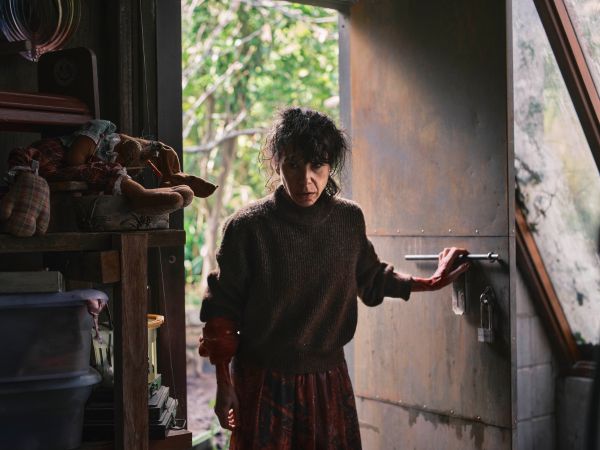
When they arrive home, they’re met with a horrifying sight Andy can see clearly and Piper can only sense: Their father has slipped naked in the shower and lies dead, face smashed against the floor. It’s not the first jarring image in the film, which features graphic, grotesque violence far more concrete than the abstract glimpses of necromantic and cannibalistic rituals shown before the credits. Considering the life-changing situation they now face, there’s a possibility Andy could legally become Piper’s guardian in a few months when he turns 18. In the meantime, to avoid being separated, they agree to live temporarily with Laura (Sally Hawkins), a former therapist for the foster care system who has the right connections to be approved as a suitable transitional guardian. A mother who lost her own daughter in a pool-related accident at home, Laura has an optimistic and sensitive energy, displaying an open concern for the children she’s just taken in.
At first, nothing seems radically off, but a few small clues hint at trouble: a taxidermied dog that changes location every day, and a third child under Laura’s care who appears permanently trapped in a trance of absolute silence. With a pinkish birthmark on his face and a vacant stare, Oliver (Jonah Wren Phillips) is an instantly creepy presence, though Andy paints a different picture when describing him to Piper. The unease deepens when Oliver tries to strangle a cat or eats things not meant for human consumption—like wooden chair legs.
Things spiral into weirdness slowly, and only Andy seems to notice. For example, Laura hosts a kind of intimate “funeral afterparty” just for the kids (Oliver is notably absent), where they play, laugh, and are even allowed to taste alcohol. She urges the boy to open up, claiming her background as a therapist will help him process his grief. Andy, slightly drunk, lets his guard down and confesses a few secrets, while Piper has already fallen asleep. This confession will all be used against him—though he doesn’t know that yet—and we soon learn that Laura doesn’t actually have the children’s well-being as her top priority.
With Bring Her Back, the Philippou brothers double down on violence and nausea, often taking the easy route of prolonged shock, leaving it up to the viewer to look away—because the camera won’t. The grotesque buffet includes necrophagy and self-mutilation, courtesy of Oliver, and rainy afternoons culminating in a flood big enough to fill the empty pool where Laura’s trauma began. However, it’s the emotional and psychological torment inflicted on Andy—and Piper’s vulnerability—that truly takes your breath away.
A role that could have easily veered into one-note villainy becomes a standout performance thanks to Hawkins’s commitment to portraying something more than a monster—until she must become one, to the bitter end, in her grief-stricken descent. The actress, already known for her outstanding work in Mike Leigh’s Happy-Go-Lucky (her breakout role) and as the unforgettable lead in The Shape of Water (a deserved Oscar nomination for Best Actress), becomes the film’s strongest asset and most captivating force. It’s a shame there’s not more Sally Hawkins on our screens every year.
Still, by the final stretch, the film seems more intent on provoking gut-level reactions than leaving behind a lasting impression. Bring Her Back is a perfect example of the post-elevated horror era. Like the Philippous’ previous feature, it works like a nightmare: You feel entranced and overwhelmed while watching (and hearing) it, but remembering it afterward may feel strangely hollow.






Leave A Comment