
My Father’s Shadow, the debut feature from director Akinola Davies Jr. and writer Wale Davies (who are brothers), begins with a striking mixture of news footage and expressionistic incantations. TV clips alert us to an especially contentious moment in Nigerian politics—election day 1993—after which a democratically elected candidate, Moshood Abiola, was prevented from taking office. The military government in charge cited undefined irregularities in the election; throughout most of the film, characters are waiting for the results.
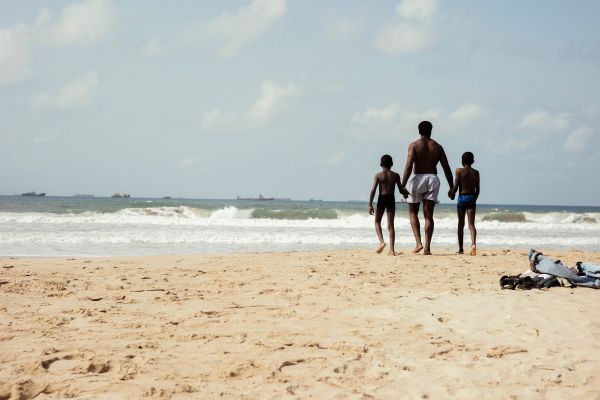
This occurs in conjunction with a child’s voice-over calling out for the father whom he declares he will see in dreams. The sequence then cuts to a house in the countryside that appears to be abandoned, with empty rooms, yet this is not the case. Two brothers, Akin and Remi (played by real-life siblings Godwin and Chibuike Marvellous Egbo), are alone on the porch. Their mother is in the village at work; their father is almost always away. Against all odds, their father, Folarin (Sope Dirisu), returns. Needing to head to Lagos almost immediately to collect his money (he has been working various factory jobs) and not wanting to leave his children alone yet again, he takes them with him for the day.
This striking film is, in some ways, a simple, realist story in which two young boys are allowed a full day with the father who they rarely see. The contradictory claims on his attention—economic, political, and familial—are hinted at and slowly teased out. The longings and frustrations of his confused sons are brought to light, though the boys are not necessarily explored as individuals.
Folarin’s goals for the day are straightforward: He wants his old supervisor to pay him, but because his boss is hard to find, he and his sons end up killing time in odd ends of the big city. It is also a story about a specific place at a specific time of festering unrest. Many characters speak their minds about the political situation openly and constantly, yet with such an unforced garrulousness that it does not come across as heavy-handed.
Yet the film also never quite loses the expressionistic mode of its opening. Indeed, though we follow the principal characters closely, there is a sense that the camera is being pulled away from them constantly: toward passersby, the wilderness, religious groups, or angry crowds hacking at a beached whale. (Yes, this does occur.) While sometimes a more surreal mode takes over—the narration from the beginning sometimes repeats, and soldiers drive by in slow motion—every briefly seen character seems to be bristling with life. Every passing scene is its own fully realized world yet also part of a cohesive whole; viewers have entered a distinctive filmscape.
Furthermore, so little of it is understood by the brothers that the sense of experiencing the world for the first time transfers to the viewer as well. (They are constantly, if silently, confused that so many people know their father.) This is a film as concerned with the environment as with its people and, consequently, ends up creating a convincing portrait of the ways that personal and political realities intertwine. If the story yields to sentimentality toward the end, its richness is still what overwhelms.







Leave A Comment