
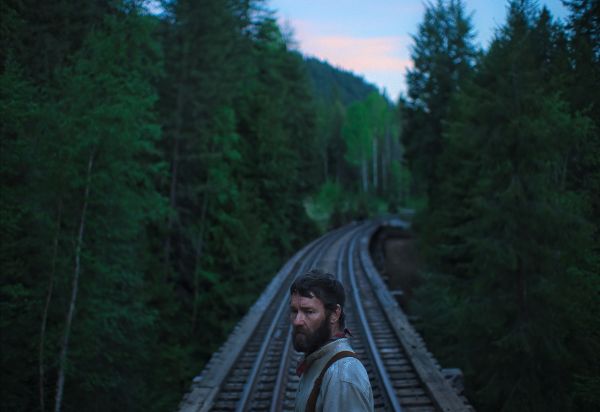
Perhaps there is no more precise symbol of industrial progress than a train in motion, or at least there was a time when it represented a future about to arrive. Humanity’s advancement depended on creating connections with the surrounding world and on the technological ability to facilitate them. Yet we rarely stop to consider the sweat and sacrifice of those who made it possible. Train Dreams, based on Denis Johnson’s 2011 novella, presents the life and tribulations of an ordinary man as an opportunity to elevate the apparent insignificance of an unremarkable individual through an epic gaze usually reserved for great figures or grand historical events that shape common lives.
Directed by Clint Bentley, with a screenplay co-written by Greg Kwedar, the creative duo (who previously collaborated on Jockey and Sing Sing) craft a singular and profound meditation. Robert Grainier (Joel Edgerton), a railroad construction worker in the early 20th-century Pacific Northwest, helps build the country as it takes shape one track at a time. Narrated by Will Patton, the film functions as a visual stream of consciousness that keeps us immersed in Robert’s life not through the logic of “notable events” that drives most biographies, but through a quiet journey that pauses to absorb what has been lived along the way.
Robert’s job requires moving from region to region wherever rail-line construction continues. He is one of those taciturn men who have found steady work, even if it means traveling far from home. The gig is decently paid but dangerous and exhausting. His coworkers rarely talk about their lives, and it is not a workplace that fosters lasting brotherly connections, even if familiar faces often return. For every occasional Bible preacher or old fellow eager to sing songs, there are plenty of men like Robert, content with the unbroken peace marking the forests they themselves invade to strip of their timber. Occasionally, an accident occurs and a worker dies, usually because of a misjudged fall of a tree being cut down, and the others hold brief funeral rites for someone they barely knew. A pair of boots nailed into a trunk becomes a fitting headstone, a minimal trace that their forgotten footprints once walked the world.
Before his next trip back to work, Robert begins a romance with Gladys (Felicity Jones), a local woman in rural Washington. Their courtship wastes little time before they settle down as a family, building a log cabin near a river and welcoming their first and only daughter. Robert, an orphan who never knew his parents, now has a true home to return to. Yet it is inevitable that his constant coming and going wears down the family dynamic, as each return reminds him that his daughter is a little older and that he is missing her childhood.
Two terrible events, at different moments in Robert’s life, haunt and shape his memory and his sense of self and place in the world. The first occurs in his youth when he witnesses the brutal murder of a coworker, a Chinese laborer (Alfred Hsing), thrown over a ravine by a group of White men who came specifically to hunt him down. At first, Robert remains passive, then lunges to grab the man’s legs as the others lift him, until a kick sends him reeling backward. The sight of such injustice becomes a dark omen suggesting that something terrible will befall him as a form of payment. The second event, which Robert interprets as that payment, arrives as a sudden tragedy from which he will never fully recover.
Train Dreams is a beautifully shot and told film distinguished by a humanistic richness that unfolds through quiet contemplation and open-ended connections. Adolpho Veloso’s cinematography adapts to the elegiac tone of the material, capturing Robert’s scenes with his family mostly in magic-hour light, while those set at work are less idyllic but no less attuned to nature’s beauty. A later wildfire scene is equally infernal and mesmerizing. The combination immediately recalls the cinema of Terrence Malick, with its overwhelming dialectic of transcendent visual poetry and philosophy expressed through careful imagery. Yet the comparison is not entirely fair. Bentley’s film is more modest in its ambitions and less esoteric for the casual viewer, who might easily be captivated by the gentle tenderness of its narrative.
Meanwhile, Edgerton has long been an underrated actor, and this role fits him like a lumberjack’s glove. He inhabits Robert so completely that he feels entirely lived-in. In a Malick film, his contribution might be absorbed as one luminous fragment within a whole, but under Bentley’s steadier and humbler direction, Edgerton’s performance becomes the backbone sustaining the movie’s central thesis: a hymn to the simple act of having lived, beyond whatever remarkable trace is left behind.
In its final scenes, Train Dreams reaches a level of lucidity and delicacy that understands life itself as a miracle worthy of being told, where the backdrop of American history does not dilute the individual importance of lived experience, with all its regrets and limitations, despite its brevity. It arrives with the warmth of a comforting film that avoids grand pretensions, becoming instead a kind of gift for anyone willing to give it a chance.










Leave A Comment