
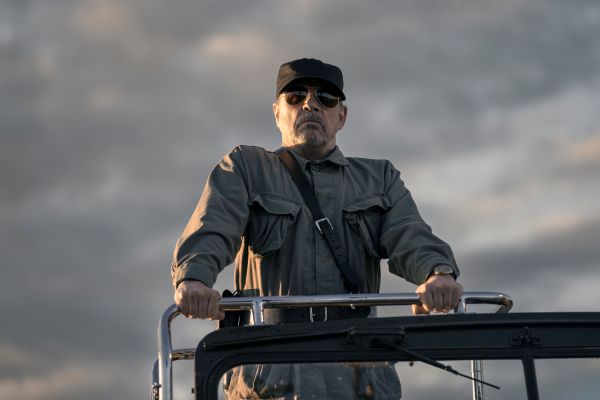
We often hear the future looks bleak. To be more objective, we’re always marching toward horror and hope in equal measure, stepping back and forth between them. This metaphor fits perfectly for The Long Walk, canonically the first novel Stephen King ever wrote (though not the first to be officially published). Initially released under his pseudonym Richard Bachman, the book portrays a dystopian America under a totalitarian regime and deep economic recession that drives young men to participate in a televised walk that grants the winner both fortune and a single wish. The rest are executed systematically as they fall behind. The walk has no goal and lasts until only one contestant remains marching on his feet.
This compelling material, published in 1979—relevant (no need to enumerate why) and ahead of its time (predating the boom of reality TV)—always seemed ripe for a film adaptation. Though the project bounced for years among directors (from George A. Romero to Frank Darabont), it finally reached the big screen under Francis Lawrence, already a seasoned architect of dystopian worlds thanks to his work on much of “The Hunger Games” saga. The premise remains intact, as does the ambiguous setting in a time that could be placed equally in America’s past or future.
Thus, 100 young men are selected in the annual lottery to participate in the infamous Long Walk, the last hope many families have of achieving a prosperous life. The contest may extend for days or weeks, and it never stops—not for weather, physiological needs, or shoe malfunctions. Each contestant must maintain a pace of no less than three miles per hour. Whoever slows down or stops gets a warning. On the third, soldiers armed with rifles—or tanks rolling alongside—execute him. Those same tanks double as cameras broadcasting the march globally, a grim reminder that the lens is just another weapon when society consumes death as entertainment.
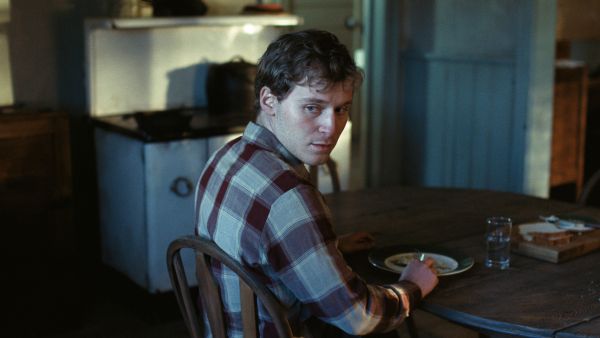
All participants know what they’ve signed up for, but desperation is the flip side of hope, since each believes in having an equal chance of winning and securing a future for himself and his family. After numbers are assigned and the rules recited by the Major (Mark Hamill), the boys gather their packs (some carrying far too much) and begin interacting with one another as a distraction. Some bonds form instantly, as with Raymond Garraty (Cooper Hoffman) and Peter McVries (David Jonsson). But camaraderie under such pressure is hard to sustain without friction. Others are more reluctant to connect, and some reveal streaks of misanthropy that make them dangerous.
Though Garraty and McVries are clearly the closest thing we have to protagonists, the film generously distributes attention across its ensemble, sketching multiple behaviors, backstories, and reactions to an experience that is absolutely cruel yet treated as routine. (The first execution lands like a hammer blow.) What lies ahead is a long and excruciating road, and if it never becomes unbearable, it’s because the growing bond between Garraty and McVries—and eventually others—keeps alive the idea that even when it’s easier to be selfish and cruel, the harder path of solidarity and humanity remains a form of resistance.
King’s novel leaned more heavily into the event as a televised spectacle, while the film plays it as something unfolding mostly with indifference from the rest of the nation. The boys and their armed escort mostly encounter desolate landscapes, with only the occasional onlooker watching with sad detachment. In 1980, a faithful adaptation might have felt too soon; in 2025, perhaps too late. (Reality TV is no longer what it was a decade or more ago.) But framed around the idea that such a horror could occur without anyone caring much, the adaptation better captures the spirit of indifference and saturation that defines our era. This also lends greater weight to the acts of kindness or rebellion from the boys—not performed for cameras or audiences, but as genuine expressions of humanity.
What’s missing here is the homoerotic tension between Garraty and McVries that King developed so pointedly. Here, Hoffman and Jonsson are charismatic and convincing in portraying a friendship that strengthens with every mile, but JT Mollner’s script eliminates any suggestion of something more. Meanwhile, elements like Jo Willems’s cinematography or Jeremiah Fraites’s score—admirable on their own—end up over-prettifying the material with a Hollywood sheen. Granted, there’s enough blood and shit on the pavement to remind us how messy and miserable this ordeal is for everyone, but there’s also just enough gloss to betray the commercial ambitions of the film’s distributor. For what it is, and what it could have been, at least we get the most stripped-down version possible.
The Long Walk is a hard watch that never loses its grip, nor turns tedious or too predictable. In place of King’s addictive prose, what we get here is the absorbing energy of its performers and a compassionate gaze. We march alongside them as silent witnesses, bracing for the worst. In that sense, the film becomes an exercise in empathy: not a measure of how much pain we can endure, but of how much compassion we’re still willing to carry within ourselves.




Leave A Comment