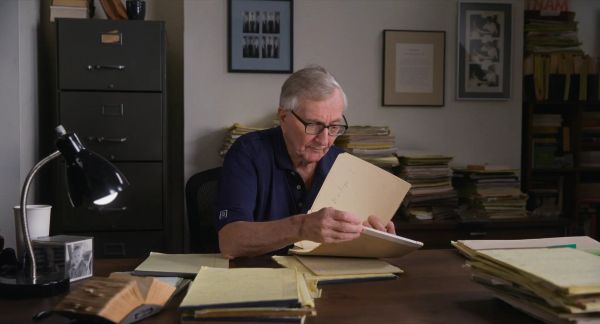
Investigative journalist Seymour Hersh became famous in 1969 by breaking the shocking news of the My Lai massacre during the Vietnam War, in which U.S. troops mercilessly killed hundreds of innocent civilians, including women and children. The army tried to hush it up, but because of Hersh’s tenacity, the story came out, eventually becoming one reason why the public turned against the war. In their documentary covering Hersh’s long career, directors Laura Poitras and Mark Obenhaus recount the events and aftermath of My Lai, and Hersh—a confident and intelligent screen presence—discusses his ability to unravel the first of many cover-ups in a long but, as the film points out, sometimes flawed career.
Now 88, Hersh is an extraordinary reporter, winning the Pulitzer Prize for his My Lai coverage. He continued to expose stories about immoral, illegal, and unconstitutional behavior in scandals like the Watergate break-in, the CIA’s secret spying program, and the abuse of Iraqi prisoners at Abu Ghraib. However, at times he went too far in his quest to break a great story: He ended up being duped by a forger who convinced him that documents proving an affair between President Kennedy and Marilyn Monroe were genuine. As a result, he had to remove the offending chapter from later printings of his 1997 book, The Dark Side of Camelot. Later, Hersh wrote a 2013 article, “Whose Sarin?” in the London Review of Books that posited that Syrian President Bashar al-Assad was dubiously blamed by the West for using nerve gas on his own people during the civil war in his country, making Hersh come across as an apologist for a murderous dictator.
To his credit, Hersh admits to getting both stories wrong, although Poitras and Obenhaus seem to let him off the hook too easily. Maybe they were afraid Hersh would rescind his agreement to be interviewed for Cover-Up, a coup that was 20 years in the making. Poitras first asked Hersh to be interviewed in 2005, but he did not want to expose any of his anonymous sources, so he kept putting her off. Finally, when Obenhaus was about to make a film about My Lai using his reporting, he agreed to sit down for a career-spanning interview.
Although there is a lot of fascinating information here—including Hersh’s harrowing account of his Jewish father escaping a village in Lithuania in the 1920s to come to the United States—most revealing are the anecdotes that highlight how secrecy and paranoia are baked into the very fiber of our government and, by extension, those in charge. When he started working at the New York Times, Hersh says that Nixon’s secretary of state, Henry Kissinger, called him, obviously worried that the reporter would not be sympathetic. (He wasn’t.) Then there is Donald Rumsfeld, George W. Bush’s secretary of defense, who sneered arrogantly at Hersh’s reporting on Abu Ghraib by parsing the definitions of what, according to him, were supposed torture and mere abuse.
Cover-Up succinctly examines Hersh’s decades-spanning reporting with judicious use of archival footage as well as incisive contemporary interviews with colleagues like the Washington Post’s Bob Woodward, the New York Times’ Jeff Gerth, and The New Yorker’s Amy Davidson Sorkin. It is also a damning indictment of the past half-century of U.S. involvement in various scandals and cover-ups that continue to this day. When Hersh says, “You can’t have a country that does this and looks the other way,” the weight of the horrific events he has reported on for decades lies within the dispirited tone of his voice, along with the recognition that journalists must keep digging for the truth, however difficult.


Leave A Comment