
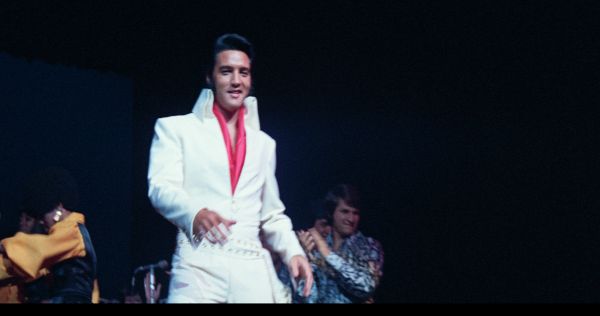
Baz Luhrmann and Elvis Presley go well together. Both have a flair for the bedazzled, the ostentatious, and the tacky, and both have a fondness for pop cover songs as well. Luhrmann’s biopic, Elvis, was a bloated, though fabulously bejeweled odyssey, guided by a charismatic lead performance from Austin Butler and stunning costumes and sets. Despite its title, EPiC: Elvis Presley in Concert is a lean 96-minute concert film, though it does have its own trappings of excess.
It begins with an overview of Elvis’s rise to fame that, honestly, could have been cut; didn’t Luhrmann plumb this thoroughly enough already? Montages of Presley’s ill-regarded movie career burst forth with quick edits, bright colors, and cheesy scenes (such as Elvis with someone dressed in a dog costume) from the 1968 movie Live a Little, Love a Little, all feeling like a surreal fever dream. There are a few interviews in which Elvis, looking haggard, sweaty, and exhausted from his tour schedule, can barely muster a response. Within his wide, black-sideburned, sweaty, and puffy face, his tender eyes still twinkle. When someone asks about him having a serious acting career, he mentions some interest in that. One wonders if Elvis had lived, maybe he could have been compelling in an emotional, complex role.
EPiC mines unseen footage from two early 1970s Elvis concert films—Elvis: That’s the Way It Is and Elvis on Tour—footage that Luhrmann’s team restored. These clips kick Luhrmann’s film into gear and perhaps highlight better than almost any other Elvis film the artist’s immense gifts onstage. He could riff, both musically and verbally, brilliantly. In one moment, Elvis quickly takes the mic to his open-buttoned top to mimic the thump of a heartbeat.
He has a genuine connection with both the band and backup singers, as well as the wooing women (many here seeming to be his young fans, now into their thirties and forties with towering bouffant hairdos) whom he invited to the edge of the stage to give him kisses. The giddy adoration is sometimes almost sad and suffocating to behold as he stands Christ-like onstage in glittery suits, bombastically belting hymns like “How Great Thou Art.” We see an artist who was an incredible pro at delivering a bravura musical performance. This made sense given how long and often he performed (sometimes three concerts a day), ruthlessly controlled by Colonel Tom Parker. Parker was portrayed villainously in the hammy, uneven Tom Hanks portrait in Luhrmann’s biopic, but he is handled more briskly here with a brief sketch. (Luhrmann plays “You’re the Devil in Disguise” over these clips.)
Butler was dynamic as Elvis, but the real Elvis is Elvis, and there are quite a few barnburners that really blaze to life here. It’s pleasing to watch the studio sessions, especially the camaraderie between himself and the musicians and singers. With ease and deep soul, Presley elegantly and lavishly covers late ’60s and early ’70s chestnuts made famous by other artists: Dusty Springfield’s “You Don’t Have to Say You Love Me,” Simon & Garfunkel’s “Bridge Over Troubled Water,” and the Beatles’ “Yesterday.” (At one point, he breaks from the song’s seriousness and humorously puts his hand above his head and looks up, noting “the shadow hanging over me.”) His low, velvety voice sometimes soars unexpectedly alongside his talented bandmates.
Luhrmann dazzles during the concert scenes, which are edited like music videos with enveloping sound design and dynamic cuts, sometimes between multiple performances. Two numbers are standouts: the sprawling “Suspicious Minds,” the chorus of which becomes deadly quiet and then gradually builds into a loud and frenzied climax, and “Polk Salad Annie,” a song that relates to Elvis’s poor Southern upbringing, which he performs with emphatic intensity. “Suspicious Minds” was particularly laid on thick in the biopic, marrying the actions of the Colonel with the lyric “caught in a trap,” the words reverberating with melodramatic effects. Thankfully, here, we just get to see Presley bang out the song with gusto. Even though in these chapters of his life, by most accounts, he was lonely and drug-riddled, it’s refreshing to see Luhrmann relish some of the joy that Elvis seems to be feeling and giving while doing what he did best under the bright lights.



Leave A Comment