
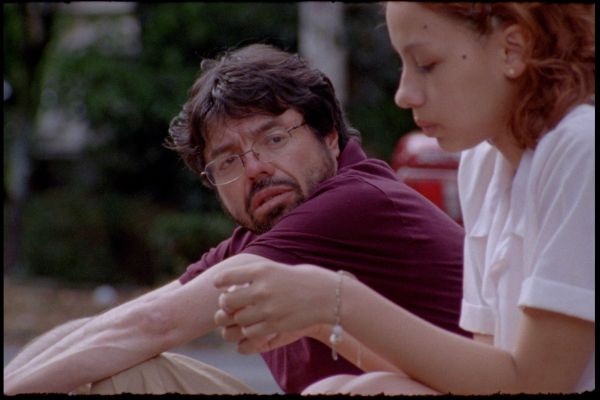
Culturally, a poet is seen as an outsider—an interpreter of otherness who can simultaneously embody the madman, the jester speaking freely, the prophet or priest infused with the divine. Yet we can all agree on one thing: No one survives alone only as a poet. This truism is endured, daily and in the flesh, by Oscar Restrepo (Ubeimar Ríos), the titular poet of the second feature film by Colombian director Simón Mesa Soto.
As a character study, Mesa Soto’s original story empathizes with and criticizes a protagonist at the center of a tragicomedy in which the pathetic outweighs the poetic. Once a promising young poet, he managed to publish two books and win first prize in a local competition. Now in his late forties, Oscar could not be in a worse place: impoverished, unemployed, perpetually drunk, dependent on a mother in fragile health, and stripped of the respect of anyone who once knew him. While his siblings pressure him to get his act together and take a job as a high school teacher—or else be kicked out of their mother’s house—his friends at Medellín’s poetry house regard him as a lost cause.
Oscar has not written anything new in a long time and instead obsesses over an idea of purity that, for him, is perfectly embodied by José Asunción Silva, a tragic figure in Colombian literature whose face appears on the 5,000-peso bill. When another drunk argues that Gabriel García Márquez is better, Oscar insists that the Nobel laureate was an overrated figure hungry for recognition. But García Márquez’s face appears on a bill of higher denomination—the 50,000-peso—and therefore his symbolic value is considerably greater. Not even poetry can escape capitalism.
If there is any saving grace in the life of this irritable, arrogant, and self-deprecating poet, it lies in his full awareness that he has not been a good father to his teenage daughter, Daniela (Alisson Correa). In her presence, Oscar appears at his most humble and remorseful, while she treats him with a certain distance and indifference—the kind of barrier one erects to protect oneself from further disappointment. Oscar wants to prove that he can change and, at the same time, help her pay tuition at a private university should she fail the entrance exam for the public one, even though Daniela and her mother have managed without his support all this time.
With good intentions and somewhat exaggerated hopes (a poet can’t avoid hyperbole, after all), he feels motivated to accept a position teaching a philosophy course. Faced with the indifference of most of the students, who laugh at his theatrically charged lectures, Oscar connects with Yurlady (Rebeca Andrade), a quiet 14-year-old. When he reads her writings in a notebook adorned with drawings, he discovers a peculiar talent: a poetry of simple things that captures an undeniable and profound beauty despite its naïveté. Yurlady thus becomes an opportunity for him to act as the father he failed to be and to mentor a poet who might achieve everything he could not.
It is within this developing relationship between Oscar and Yurlady that the film rises and demonstrates Mesa Soto’s talent for steering clear of clichés and sentimentality while still making sharp sociocultural observations without losing its sense of humor. As a teenage girl with few opportunities ahead of her (her older sisters already all have children), Yurlady allows herself to be guided by Oscar with little interest in his promises, but with enough shrewdness to extract any immediate benefit that might result—groceries for her family, a new bottle of nail polish, or the possibility of winning prize money from a poetry contest. At the poetry house, where Oscar takes her to compete, everyone is dazzled by Yurlady, but it quickly becomes clear that they see in her the perfect symbol to promote the institution and secure sponsorships.
Oscar may not be a great poet, but his integral understanding of poetry and his respect for it place him consistently in a position where his behavior is never constrained by social conventions and is often embarrassing for others. His mentorship of Yurlady ultimately leads to disastrous circumstances, and it is here that the movie holds firm in refusing easy or manipulative paths. A Poet is largely a black comedy, and, on a more universal level, it expands its critical gaze with sharpness toward the intellectual ouroboros of closed cultural circles that often operate through hypocrisy and tokenism.
At the center of it all stands the extraordinary performance of Ubeimar Ríos, revealing a late newcomer who seems to have been born to stand in front of a camera. It is astonishing that this is his first acting role, and anyone outside Colombia would immediately assume he must be a seasoned veteran. If Mesa Soto has written an instantly memorable and complex character on paper, Ríos has transformed Oscar Restrepo into a playful symbol of defiance and stubbornness that may become an iconic figure in Colombian cinema.





Leave A Comment