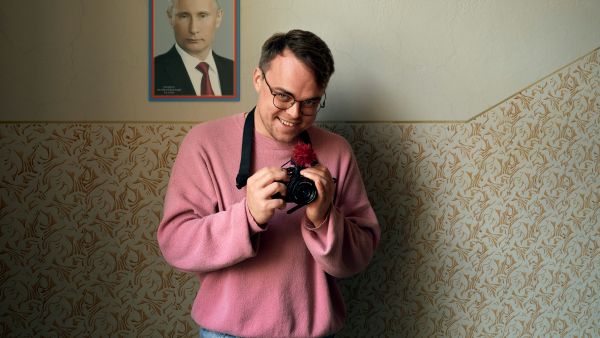
Pasha Talankin was, until the summer of 2024, the events coordinator and videographer at Karabash School No. 1, the largest school in a small town in Russia’s Ural Mountains region. Talankin videotaped every major event at the school—choir performances, bake-offs, and even student-created music videos—and seems to have encouraged the participation and expression of his students at every stage of the process. His office was a haven for them; as a self-confessed oddball and an alum of the school himself, he felt it was important to create an environment for his students that he never had: a place of warmth, acceptance, and exploration. Talankin was even present to film graduation parties for his departing seniors and stayed in touch with graduates long after they had left.
This changed in 2022, when Russia fully invaded Ukraine. Though Karabash is a small town deep in Russia’s industrial heartland, it was affected in a significant way, and not simply because its youth left town to join the army. After Putin announced his special military operation, federal orders went out to schools to institute a new education policy. Students were now required to perform patriotic songs and speeches, teachers had to give scripted lessons about Russia’s greatness and the evil of Ukraine, and, gradually, the children were expected to attend demonstrations given by military personnel. Talankin, as the school videographer, was expected to record it all.
Though Talankin did quit in protest at one point, he ended up taking his job back for unexpected reasons—filmmaker David Borenstein, introduced to Talankin by a Russian colleague whom the teacher had reached out to on Instagram, contacted him with a proposal: to make a documentary about what was happening at his school. Talankin accepted. Mr. Nobody Against Putin is the result of his efforts.
The documentary is narrated by Talankin, whose school footage is interspersed with his own commentary, autobiography, quick history lessons, and interviews with students around town. Like many films with a cause to push and a subject with a personal angle, it occasionally succumbs to cloying grabs for sympathy, especially at the end. There were also times this viewer was curious to know more about the varying attitudes of townspeople regarding the political climate rather than simply Talankin’s own, though we hear and see plenty from teachers and students. However, this film offers an invaluable and chilling picture of a propaganda machine at work in the everyday lives of those under its thumb.
Talankin’s point of view is clear throughout, and it is often moving to hear him voice his deep love of Russia and how it is at odds with the false patriotism he perceives in Putin’s agenda. His footage is shot and chosen with care and mostly journalistic objectivity, which allows the horrid situation to speak for itself. He is especially concerned with children who have family members at war and with students whom he suspects might join the military. Impressively, he does not judge any of them. Consequently, he allows us a convincing glimpse into how the war hurts and misguides people on both sides of the political divide. (A pro-Putin history teacher, however, does not escape his wrath.)
The scenes of scripted lessons are striking for the way they reveal propaganda at work and how the students appear alternately bored, confused, and stunned by them. Later, at a teachers’ meeting, there is a muted discussion of how students are failing to perform well in all subjects. No one is allowed to say in public that this might be because they are exhausted by the extra hours of propaganda.
That Talankin managed to record all this in increasingly dangerous circumstances is impressive enough. (The kids start avoiding him because he is adamant about his own views.) Even more remarkable is that he did it so decisively under these conditions. If this viewer found himself wanting to know even more, that is, perhaps, to the film’s enormous credit.



Leave A Comment