
Only seven months have passed since the release of 28 Years Later, the long-awaited third entry in what has now become a horror franchise that began with 28 Days Later (2002). The weeks and years portrayed in subsequent films have continued to explore the disastrous consequences of a laboratory virus accidentally unleashed, giving rise to the infected who—alongside survivors forced to adapt to such a horrific reality—remain contained within the mainland of Britain, isolated and blockaded by the rest of the world. The most recent installment, which marked the vital return of Danny Boyle and served as a high point for the saga, left us eager for more. Fortunately for those who enjoyed that chapter, a direct sequel was produced concurrently and strategically scheduled for release in early 2026, albeit with a different creative team led by director Nia DaCosta.
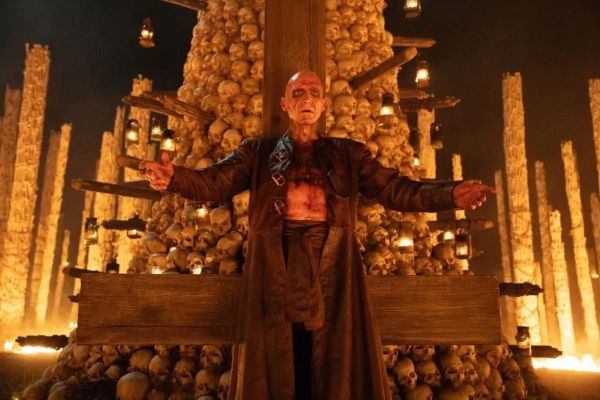
The proximity of 28 Years Later: The Bone Temple as a sequel is unusual, but the timing is ideal for keeping the characters established in the previous film fresh in our memory. On the other hand, it runs the risk of relying too heavily on the merits of the previous chapter, one of 2025’s best horror films. This quickly reveals itself as a crucial flaw; while it does not ruin the movie, it does register as a case of being too much of a sequel for its own good. The movie is highly dependent on audience familiarity with past characters and events. Still, the opportunity to reunite with Dr. Ian Kelson (Ralph Fiennes), who is guarding and expanding his “bone temple,” delve deeper into the mystery of the gigantic Zombie-Alpha, Samson (Chi Lewis-Parry), and discover the fate of Spike (Alfie Williams) after his unsettling encounter with Sir Lord Jimmy Crystal (Jack O’Connell) proves irresistible.
Accordingly, several simultaneous storylines interweave. The strongest passages are those centered on Kelson and his successive encounters with the infected giant he has named Samson. It is a fitting biblical reference for a creature of such immense physical strength—one capable of severing heads with the spinal columns intact to raise as trophies. The doctor manages to domesticate this fearsome beast through sedatives, creating an unprecedented dynamic where Samson approaches Kelson expecting another dose of narcotic arrows. The solitary Kelson, who spends his days dancing to Duran Duran songs and tending to the ossuary that pays tribute to those who have died from the infection, finds in Samson both a companion and a patient. This meditative, melancholic tone continues the franchise’s tradition of attending intelligently to the human dimension as much as to the eruptions of violence and jump scares.
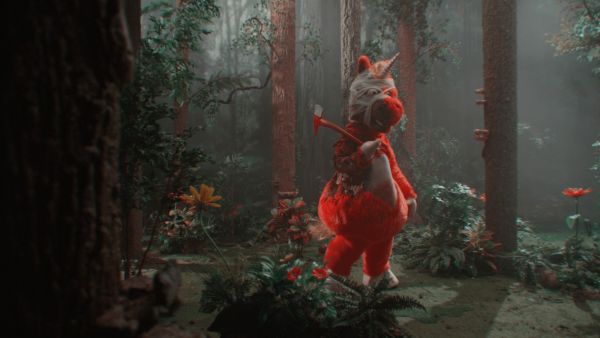
By contrast, the sections focused on Jimmy and his group (all of whom are named Jimmy) progressively weaken the film. Jimmy’s excesses and rampages feel like a different movie altogether, one that could exist without being integrated into this universe. In fact, it is surprising how little we see Jimmy’s savage gang confronting the infected undead. Instead, the most violent and grotesque scenes involve their attacks on other uninfected people. The figure of Jimmy is modeled after Jimmy Savile, the British media personality posthumously exposed as a predator. O’Connell constructs a frightening, charismatic villain who forces his followers to torture prisoners through what he calls “charities” (gruesome acts such as slicing the skin off someone’s torso as if removing a shirt).
Spike, who earned his place in the group after winning a knife duel to the death, remains on the periphery of this horror. Picking up immediately after the events of the previous movie, he is still a lonely, resilient kid forced to join this new tribe for protection. Williams’s moving and layered performance in the previous entry revealed an admirable talent capable of carrying a movie. Here, he feels one-note due to a script that keeps him sidelined. His weak narrative arc feels like a disservice to the maturity previously demonstrated in the earlier film’s devastating coming-of-age story.
On the heels of her stylized version of Hedda, Nia DaCosta returns in blockbuster mode to inherit a franchise steeped in action, aided by a script from Alex Garland—writer of both the first and third entries—which helps preserve a certain narrative continuity. Still, it is hard not to miss the director-cinematographer partnership of Boyle and Anthony Dod Mantle. In their place, DaCosta and cinematographer Sean Bobbitt opt for a more organic and functional style. While there are a few inspired flourishes, the film ultimately feels more aligned with Samson’s sedated domestication than with a frenetic, lethal world. As a consolation prize, however, the movie delivers a magnificent sequence set to Iron Maiden’s “The Number of the Beast,” in which Fiennes, in beast mode as an actor, unleashes an overwhelming musical inferno that must be seen rather than described.
28 Years Later: The Bone Temple is, at best, serviceable—a kind of obligatory narrative stopover that confirms this saga is poised to expand. As a January release, it is at least worthy of the big screen, managing to entertain more than the typical “dump month” fare. With the major talent involved and the visual scope intended for premium large-format screens, it leaves one with the feeling that the new year for cinema has officially begun.



Leave A Comment