Emergent City is an alternately fascinating and frustrating documentary that takes on an issue facing nearly every major U.S. city: gentrification—and what to do with property or buildings that have outlasted their original use.
In this case, the subject is Industry City, a collection of buildings near the waterfront in Sunset Park, Brooklyn. Back in the day, it was a thriving industrial pier that sent products out to the world. Today, it’s an upscale hipster enclave filled with small businesses, restaurants, and a phalanx of offices. (I’ve been there multiple times. It’s a lively place.) Sunset Park is a lower-middle-class, multi-ethnic neighborhood—the exact type of area that tends to be transformed out of existence.
There seems to have been a tenuous peace between Industry City, owned mostly by the developer Jamestown Properties, and the rest of the community. That is, until a rezoning application is submitted that would allow Industry City to expand into hotels, dormitories, and even more retail and office space. Understandably, some community members are more than a little jittery. UPROSE, a local environmental action group, proposes an alternative plan to repurpose the space for climate protection and sustainability. Meanwhile, Carlos Menchaca, the newly elected city council member, tries to straddle the line and negotiate between his constituents and Industry City—here represented by Andrew Kimball, who is genial but disingenuous at times. For example, he demurs when asked how much profit his shareholders plan to make after the rezoning—any company would have worked that information out.
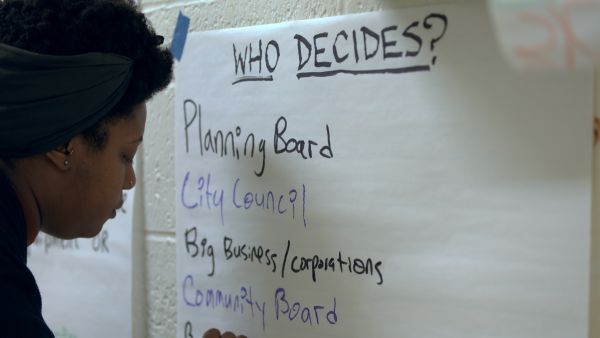
What Emergent City, directed by Kelly Anderson and Jay Arthur Sterrenberg, does very well is create a fly-on-the-wall atmosphere in the community board meetings and negotiations with Industry City reps, as well as in the strategy sessions of various groups opposing the rezoning. The filmmakers meticulously walk us through the process, stringing events together. It’s alternately inspiring and infuriating as we watch people muddle through disagreements and personality clashes to hammer out proposals. UPROSE is inspiring and driven, but quick to shout down dissent, while Menchaca makes decisions that affect the community without consulting them—and then, weirdly, feels blindsided by the blowback.
Anderson and Sterrenberg tip their hand considerably when they contrast children and families playing in parks and streets with millennials scrolling on their phones in Industry City’s courtyards, and a man handing out mandala coloring books to patrons while asking, “When was the last time you were creative?” The message is clear: one is authentic, and the other is not.
On the other hand, Kimball makes some salient points about his vision and how cities change. You can certainly disagree with him—as I mostly do—but the film doesn’t seem to give his perspective much credence. He’s mostly shown promoting the project.
After all the emotional tugging and pulling, and the constant anxiety of the participants, the wrap-up feels reminiscent of the last season of Game of Thrones, so quick and tidy that it doesn’t leave space for either the participants or the viewers to absorb the outcome.
Still, it’s a film worth seeing, especially in a time when, politically, a chunk of the country simply wants results without the hassle, without realizing that the hassle is what makes democracy work.



Leave A Comment