
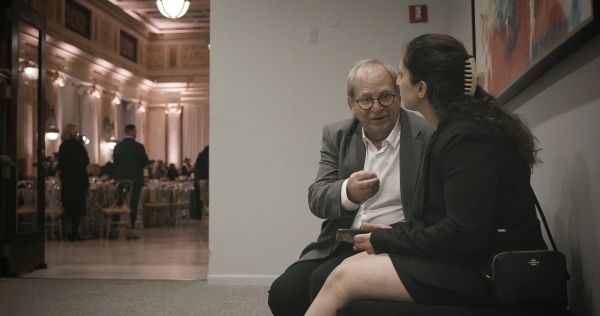
On October 7, 2023, married couple Liat and Aviv Atzili were among the roughly 250 people kidnapped and held hostage by Hamas. They lived with their children on Kibbutz Nir Oz, which, by the time Liat’s parents, Yehuda and Miriam Beinin, managed to arrive, was completely ransacked. There was no way of knowing if the couple was still alive. Shortly after, the war in Gaza commenced.
Yehuda and Miriam were contacted by filmmaker Brandon Kramer, a distant relative living in the United States. He learned that Yehuda was planning to travel to Washington, D.C., Kramer’s hometown, to help pressure the U.S. government to aid in the release of the hostages. Holding Liat follows Yehuda and Miriam as they struggle through the period of uncertainty before Liat’s release, documenting Yehuda’s attempts at advocacy and Miriam’s more withdrawn approach of simply living her life and taking care of her grandchildren—one of them, Netta, accompanies Yehuda to Washington. Throughout, there are interviews with Liat’s sister Tal and Yehuda’s brother Joel, as well as ample footage of Yehuda’s time at protests and in the Capitol. The viewer quickly grows accustomed to the sight of Yehuda staring anxiously at his phone.
This is one of many recent documentaries to offer a privileged glimpse into a horrific situation as it is lived by its subjects. In its premise alone, it runs the risk of simply milking their anxiety and pain for the supposed edification of the viewer, as well as reducing a maddeningly complex situation to the reality of one family. Yet this affecting and engaging film quickly becomes something different, and by the end, it takes on a global, rather than strictly personal, focus.
Yehuda, out of both strength and political temperament, is determined not to see the predicament as an opportunity to give Prime Minister Netanyahu a pass for his actions in Gaza. Throughout, he repeatedly states that his country is being run by crazy people, that there are crazy people on both sides, and that no act of violence will provide healing or peace of any kind. He openly disagrees with the much more conservative Israelis he finds himself among in Washington and, admirably, seems to maintain this point of view even while his daughter is in captivity. Though he slips sometimes—when his brother states that Netanyahu’s actions in Gaza are ensuring future members of Hamas, Yehuda is surprisingly ambivalent—he mostly stands strong. His time in Washington is a telling portrait of how others twist a narrative to their own political ends, and it is clear from his and Netta’s experience talking to politicians that they are all too aware that they must put forward a narrative of sorts to win sympathy. It is also vividly made apparent how difficult it is to maintain compassion and broad-mindedness in the wake of an atrocity.
This documentary takes every opportunity it can to ask the viewer to step back and consider the whole picture. Impressively, this is achieved without talking heads outside of the family or animated history lessons. Its principal figures believe that there is no understanding what is happening in Israel and Palestine today without acknowledging and accounting for the 1948 regional war, while also remaining dedicated to the belief that coexistence and healing are possible. Even if this message is sounded throughout, we are never made to believe that this will be easy or to assume that it is even probable—flashes of hateful protests and contorted faces hammer home exactly how hard this is. While it is certainly possible that unsavory statements were edited out to present a more compassionate whole, I admire this film for holding so many contradictory ideas at once.








Leave A Comment