
There’s a moment in Werner Herzog’s 2020 documentary Fireballs: Visitors from Darker Worlds when a scientist falls to his knees in the snowy plains of Antarctica and breaks down in tears. He has just made an important discovery, one that validates his many years of research. Herzog interjects, stating that this is exactly the kind of detail that “stupid … film schools would never allow,” since it does not unambiguously contribute to the larger narrative. Herzog, of course, shows it anyway.
Werner Herzog’s documentaries are as notorious for the large questions they ask as for the curiosity they inspire. He will not be stopped from including any stray fact or incident that interests him, and many of his films are concise despite this tendency. If his ancient-sounding voice is as easy to ridicule as his impossibly vast areas of inquiry, there is no denying the sense of wonder instilled by his best efforts. If these documentaries ever fail, it is because he neglects to acknowledge the troubling implications of some of his material (Theatre of Thought, which examined computer-brain interfacing, is a fine example of this misstep).
Ghost Elephants, his newest offering, is especially rich in incidental detail. The film follows conservation biologist Steve Boyes on a journey into the Angolan highlands to find the remaining descendants of the largest land animal ever discovered. This elephant, Henry, is preserved at the Smithsonian Institution in a massive taxidermied display. Henry was poached by big-game hunter Josef J. Fénykövi in 1955, who wrote about his conquest in Sports Illustrated. While Boyes has some trouble defining his exact goals in trying to locate Henry’s descendants, it is clear his quest is one born of reverence and respect for nature.
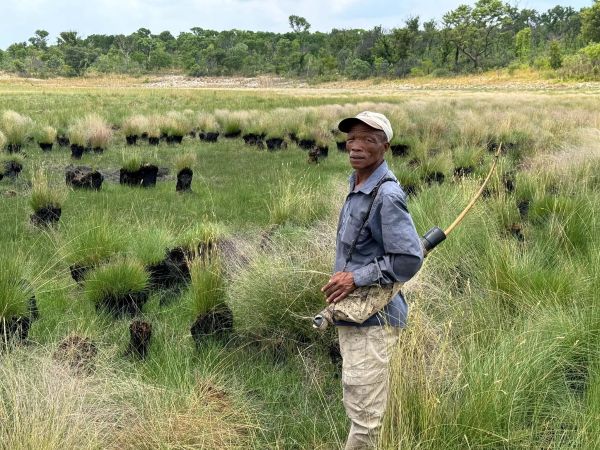
While the journey into Angola’s 4,000-foot-high Bié Plateau in search of these fabled “Ghost Elephants” forms the bulk of the film’s structure, Herzog is especially determined to bring to light anything that strikes his fancy. These nuggets are often more arresting than the central subject. Special regard is given to the San people (Namibia’s Bushmen), who are enlisted to help Boyes track the elephants. Although we learn of their tracking methods (they can tell if an elephant has passed through by looking at trees), we also learn of some of their customs, their history, and the ways they make poison for shooting antelopes (it involves digging a certain bug out of the ground). We also hear of the effects of said poison if it touches an exposed cut on a human hand (it’s not pretty). Even that long list feels like just a taste. Herzog makes it clear that his intention is to honor them. He also addresses their history of marginalization.
There are also non-elephant animals (a certain spider that carries all of its eggs on its back, an enormous lizard) which receive brief, illuminating shocks of attention; traces of Angola’s brutal 27-year civil war (an expert in biodiversity speaks to the way animals were wantonly slaughtered in this conflict); and staggering facts of the natural world (the Bié Plateau contains enough water to supply California 10 times over). These details, and many more, feel as though they could each be a film in themselves.
Ghost Elephants is not unsatisfactory per se when it comes to Boyes himself and the pursuit of the elusive elephants, but some elements are likely to give viewers pause. When Herzog asks Boyes why he wants to find Henry’s descendants, Boyes gives a stoned-sounding non-answer. In short, he replies that maybe it’s better if he never does, so the dream won’t die. Herzog asks this question twice. The second time, my gut response to the question was: Why wouldn’t you want to find them?
Even halfway through, the documentary has rekindled enough interest in the natural world to make this seem like a valid pursuit in and of itself. Yet poaching and other forms of violence toward animals (like that in the Angolan war) also come up frequently, which raises the question of whether these elephants are better off undiscovered. A line of text at the end informs us that Boyes is working to maintain the Bié Plateau as an area of conservation. Still, it is hard not to feel that the subject should have been raised more explicitly. So many others were.
Nevertheless, this viewer came away enlivened and entranced, and it’s worth noting that supposedly incidental details do not feel so arbitrary by the end. Herzog’s insistence on capturing everything remarkable that surrounds him has the cumulative effect of convincing us that there is always more to see and consider, everywhere we go. Ghost Elephants is yet another example.








Leave A Comment