
Daily coexistence and the passage of time turn relationships into a test of endurance: either love holds, or it collapses. But does that mean both partners should feel they can’t live without each other? Does that romantic notion ultimately translate into codependency? These may not be the thoughts you bring into a horror movie, but they’re certainly worth considering after watching Together—especially once you meet its central couple and the closed-off world they’ve chosen to confine themselves in.
To be exact, Tim (Dave Franco) and Millie (Alison Brie) are first introduced through the public perception others have of them, at a party held in their honor. He, the introverted half of the couple, spends more time than necessary in one of the rooms, searching for a vinyl record. She, more on the life-of-the-party end of the spectrum, urges him to rejoin the festivities as soon as possible. No, it’s not an engagement party, and it’s far from a wedding, a baby shower, or any milestone event you might expect from a couple who’ve been together for 10 years: Millie announces she has accepted a job teaching English at a primary school. Tim will simply follow her without making any plans for his own future. As a result, their friends won’t be seeing them often from now on: The couple is moving to the countryside.
Since they met, Tim, an aspiring musician, has been hoping to achieve some sort of success. His close circle of friends and bandmates suspects that the move will only pull him further away from his supposed dreams, throwing in barbed comments like, “When I die, I don’t want to see someone else’s life flashing before my eyes.” They know him—and his dynamic with Millie—well enough to suspect that Tim’s will and agency matter very little when it comes to such a big decision.
The farewell party ends on a rather pathetic note when Millie improvises a marriage proposal, dropping to one knee and pretending to hold an invisible ring. Tim doesn’t know how to react, assuming it’s a joke, and only realizes too late that his prolonged hesitation is turning into her public humiliation. They go to bed estranged after a brief argument about whether they’re truly making the right choice. In the next scene, now settled into their idyllic country home, it’s clear they’ve decided to go through with the move and stay together.
Surrounded by miles of forest, they’ve placed themselves in the perfect setting for a horror film: an isolated environment where—even if nothing overtly supernatural happens—anyone can go crazy from a lack of contact with the real world. The premise embraces both kinds of horror tropes and borrows from other genres too.
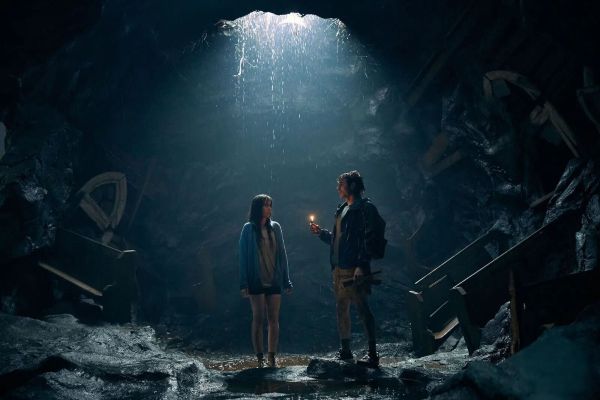
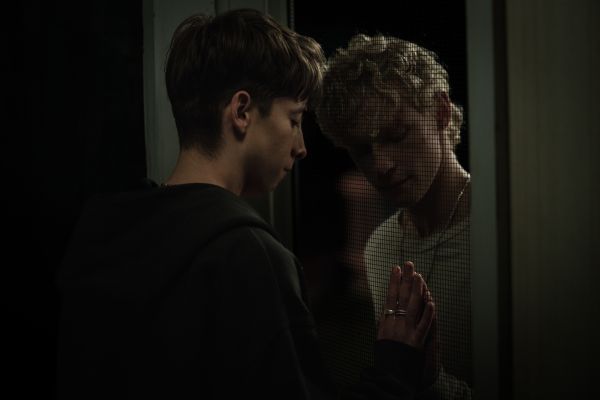
Without giving away more than what the film’s marketing already teases, Together involves the mystery of a nearby underground cave and the effect it has on those who visit it and drink its waters—something the couple ends up doing by chance after getting caught in a storm. Previous signs, like the corpses of several rats fused to the ceiling or a living dog in apparent decomposition with two heads, suggest that Tim and Millie may be exposed to a strange affliction, one that also sets the stage for body horror experiments used here as not-so-subtle metaphors for the conflicts that either destroy or strengthen a relationship.
This is the feature debut of Australian director Michael Shanks, working from his original screenplay. As a horror film, the premise is creatively risky and instantly appealing. The blend of practical effects and CGI is admirable and convincing. The chemistry between the actors adds a layer of sensuality to the visually grotesque body horror sequences, which are also laced with a dose of macabre humor. A quick hookup in a bathroom stall turns into a tense, hilarious scene that gives literal weight to the phrase “stuck on you.” The genre fusion works well for the most part.
However, in the dramatic department—which is crucial here, given the setup—the film comes up lacking. You may think it’s not essential for this particular couple’s portrayal to turn fully into Marriage Story (although, why not?), but the arguments and disagreements between the leads end up feeling more functional than immersive, serving to move the plot forward without ever becoming emotionally powerful. Let’s recall a film like Nicolas Roeg’s Don’t Look Now (1973), for example, to see how an excellent horror movie can also serve as an intense, painful, and unpredictable portrait of a couple in crisis. Shanks only manages to scratch the surface of a level he himself sets high enough that we’re justified in expecting more.
In any case, Together delivers a solid dose of horror, humor, and romance, proving just how mainstream and accessible body horror has become (partly thanks to The Substance), for better or worse. At the same time, it invites a reconsideration of love as a constant waltz of friction and distancing—a struggle between the defense mechanisms of the individual self that resists sacrificing freedom, and the shared aspirations, memories, and desires between two people trying to form a unified whole. Perhaps the most terrifying possibility is also the most desired: to vanish into someone we love.





Leave A Comment