
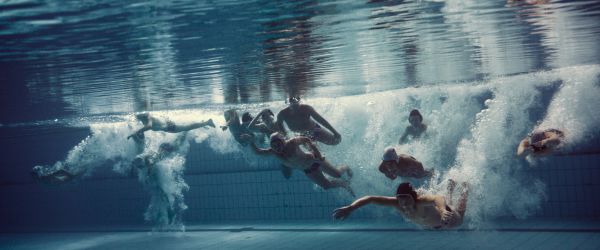
Charlie Polinger’s visceral debut feature is set at a California school in the summer of 2003, where 12- and 13-year-old boys attend a water polo camp. Ben (Everett Blunck), newly arrived from Boston, is a quiet, seemingly amiable kid who wants to fit in. Though Ben’s Boston accent is barely noticeable, the kids mock it, dubbing him “Stopy” for the way he pronounces “stop.” This innocuous teasing is mild compared to the barrage of cruelties that follows, like putting skin-crawling roaches in someone’s bunk bed.
Early on, when the coach, nicknamed “Daddy Wags” (Joel Edgerton), asks the boys what water polo means to them, Ben earnestly says teamwork and unity, but the group quickly reveals itself as an unruly gaggle of smart alecks, cutting up and leaving a crude doodle on the coach’s dry-erase board. (It’s a penis.) Overall, Wags, weary and lackadaisical, supervises and disciplines the crew at the bare minimum.
An autistic kid, Eli (Kenny Rasmussen), with a severe eczema-like skin condition—itchy red welts cropping up all over his front and back—is the brunt of all the kids’ ridicule. The boys steered by cruel ringleader Jake (Kayo Martin), tease Eli relentlessly and say that he has “the plague.” If they get too close to him, they immediately run to the gym shower and gleefully scream, “The plague!” When Ben begins to develop acne on his face and painful eczema on his torso, he fears he too has been “infected.” The boys notice Ben has begun breaking out, as well as his kind gestures toward Eli, and begin to exclude him as well.
The intense, effective score by Johan Lenox amplifies the atmosphere of fear and anxiety. When Ben nervously approaches the lunch table for the first time, the music sounds like a low, gasping breath in syncopated rhythms. A recurring motif of an airy, eerily melancholic French pop melody floats over many sequences. When the all-girl swim team briefly appears, it performs a synchronized dance to All-4-One’s corny “I Swear,” a staple of millennial junior high dances. After all the kids sneak out with a bottle of alcohol to an abandoned lot, Eli suddenly cuts loose to the frenetic tempo of Moby’s “Feeling So Real” in a fleeting moment of freedom that’s quickly ridiculed by others.
Shot on 35 mm, Steve Breckon’s cinematography is consistently evocative. Exquisite shots of bodies treading water in the turquoise pool look like moving oil paintings. Sometimes the camera pans slowly into faces or follows behind characters as they move down hallways, evoking memorable, foreboding sequences from Gus Van Sant’s teen bullying elegy Elephant. Brian De Palma’s Carrie is a significant influence here, both in theme and in its visuals. A scene where Wags chastises the kids for their behavior, as the camera moves behind their lined-up backs, is nearly identical to Betty Buckley’s gym coach Miss Collins in De Palma’s thriller as she berates Carrie’s bullies. (Wags’s mustard and navy shirt and hoodie ensemble even mimics the coloring of Carrie’s gym uniforms.) The film also hints at building toward a climactic gymnasium dance summer soiree. Mostly working in commercials, shorts, and music videos, Breckon exudes formidable promise and flair.
Though shot in Romania, the sickly lit school setting, with its dented lockers and eerie corridors, could be any off-season school in an American suburb or small city. One can almost smell the gag-worthy cafeteria lunches of depressing-looking fried chicken and French fries under heat lamps.
Blunck, an auspicious young actor, has displayed impressive versatility in two films this year: the somewhat subdued tween here and the more frenzied, ambitious aspiring young theater kid in Griffin in Summer. Martin’s Jake is the film’s most infuriating presence—subtly and overtly cruel and manipulative, with a mop of ginger hair, mischievous eyes, and a mischievous overbite grin. It’s hard to separate the actor from the turn; it’s a chilling performance. Edgerton, an actor of steely, quiet strength and sensitivity, particularly in this year’s Train Dreams, recedes more into the background here. At one point, the coach tries to comfort Ben with a pep talk over diner food, sharing his own childhood traumas, but his effort is ineffectual as Ben wants to be out of his growing pains now, not wait until he’s older. Here, the kids dominate over the mostly invisible adults in Lord of the Flies–type fashion.
In this time of talk and debate about masculinity and the crisis of young men, The Plague offers haunting depictions of teenage boys in turmoil. They would be in their mid-thirties now, and one wonders where all that meanness, aggression, hurt, and anxiety has led them.









Leave A Comment