

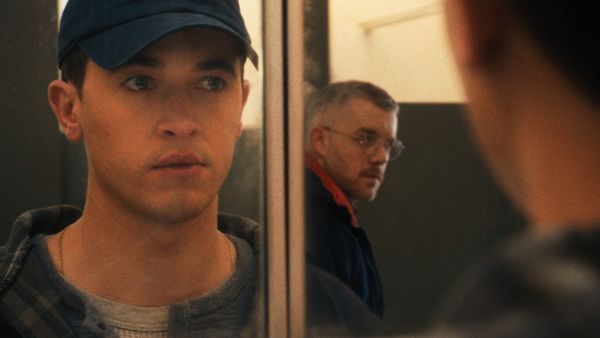
An understated, thoughtful, and empathetic character study, Unicorns follows a potential love story between a seemingly unlikely pair: a White, straight, taciturn Essex mechanic, Luke (Ben Hardy), and a gay Indian drag queen, Aysha (Jason Patel, in a notable film debut). The two meet by chance when Luke wanders into an underground club where Aysha is performing. Initially attracted to her, he becomes immediately unsettled once he realizes she is not a cis woman. A few days later, their paths cross again when Aysha—who doesn’t drive—shows up at Luke’s garage, asking for rides to her nighttime gigs. They strike a deal: Aysha will help cover his driving hours and fuel in exchange for a small percentage of her earnings. Luke, raising his five-year-old son Jamie (Taylor Sullivan) on his own, agrees, needing the extra cash.
There’s chemistry and tenderness between the two (aided by Hardy and Patel’s effective performances and Stuart Earl’s gentle score), and they eventually seem to be falling for each other. However, both are grappling with personal issues that hold their relationship at bay. Outside of the persona of Aysha, Ashiq—who comes from a conservative Muslim family—works in a pharmacy. Sometimes he sneaks in excellent makeup tips for a customer; otherwise, he’s relegated to stocking shelves.
In one of the film’s most poignant scenes, he visits his mother (Nisha Nayar) after three months apart. She is visibly heartened to see him. They dance joyfully to Hindi music—quickly, before the “boring men” (as she refers to her strict husband and son) return home—and Ashiq does her eyeliner. Still, likely out of denial, she asks him if he’s met a woman yet. This fleeting moment, my favorite in the film, unfolds within the hushed, lived-in atmosphere of their home, carried by earthy, genuine performances and the layered relationship between mother and son, shaped by both what is said and left unsaid.
Through the use of color and lighting, David Raedeker’s cinematography (The Souvenir and The Souvenir Part II) emphasizes the divide between the vibrant, idealized worlds the characters escape into and the duller, more melancholic reality they inhabit. The film is visually dynamic, especially in the neon-lit club scenes and a detour to a colorfully lit fairground, where Aysha, Luke, and Jamie enjoy a night out together on carnival rides. These moments stand in sharp contrast to the everyday drabness of dive bars, fluorescent-lit shops, and low-rise apartment complexes.
For this kind of quiet, slow-blooming relationship movie, a two-hour runtime feels too long—though I can’t point to anything obvious to cut. A violent incident late in the film registers more as a plot contrivance, to potentially tear the pair apart. Still, while the pacing can drag, the film’s patient and detailed character development is ultimately rewarding.







Leave A Comment