
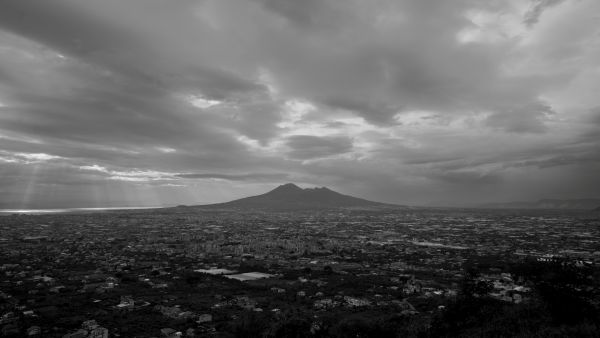
The ancient volcano Vesuvius rumbles balefully over Naples, casting a shadow on the souls below—citizens can only tensely wonder when an eruption will finally boil over. In the third film of a celebrated Italy trilogy, Gianfranco Rosi has created a somber, eerie study of the city in black and white. Here we sense not only that perils constantly threaten to crack the ancient stronghold’s surface of shabby modernity, but that they’ve never really gone away.
Rosi records fragments of the city’s life and lives with his signature fixed camera, an absence of narration, and glancing, atmospheric music. Naples’s topography is a visual anchor. Seen in wide shots from above, sometimes in darkness, Naples looks part crime scene, part modern-day ruin; concurrent images of Pompeii, forever trapped in the ash that engulfed it in 79 A.D., reinforce the sense of stasis and decay.
The film follows several individual themes that together coalesce into a deeper portrait of the town and its relationship to an ever-present anxiety. Trains and bulldozers hurtle forward as if to defy unspoken paralysis. First responders take panicked emergency calls when citizens feel earthquake tremors; they listen and try to reassure but can do little to help, revealing a system under strain. A lonely Syrian refugee unloads grain from a stalled Ukrainian cargo ship. A historian reflects on the past, surrounded by silent artifacts. And a seismologist drily kibitzes with his family, providing a rare note of humor. They deal with a constant threat, but the film seems to remind us that their—and our—presence is fleeting.
Visual metaphors add meaning and unease to the work’s languid pace. The posture of prostrate religious pilgrims echoes the silent contortions of the victims caught in Pompeii’s fatal eruption. A pile of grain resembles first a haughty pyramid, then the volcano itself. A museum expert ambles through a dark storeroom with a flashlight, shining a light on impassive marble statues whose carved faces have witnessed and endured the violence of the centuries. Smoke billows from underground early in the film; later we see lava splashing in bursts, then finally oozing in buttery layers. The heat is getting closer, the movie seems to tell us.
Every city records scary emergency calls; every municipality faces danger and bears scars from past traumas. Sometimes it feels as if Rosi is portentously stretching his allegories to scare us with the premonition of disaster. But the mounting depredations accumulate power. A disgusted investigator decries grave robbers’ looting of Naples’s glory. A ghostly abandoned village looks ready to fall into the sea. How long can these dire conditions last? Forever, as it turns out. As the museum official remarks, “Time destroys everything, preserves everything, and then returns to us in unexplained, unforeseen ways.”
For all its setting’s evolution as a busy modern metropolis, Pompei: Below the Clouds skillfully marshals timeless forces to remind us of eternal threats to its existence.










Leave A Comment