
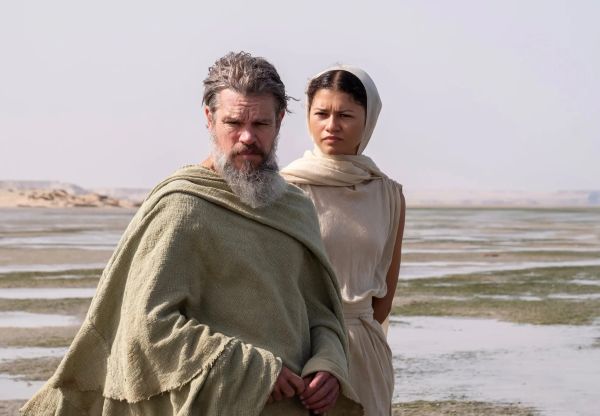
For this longtime fan of Greek mythology, the Percy Jackson books, and Christopher Nolan movies, The Odyssey feels like a match made in heaven. The director has always shown a flair for grand stories about cunning yet flawed male leads, and Homer’s epic of the Greek hero Odysseus more or less invented that archetype for Western literature. At the same time, Nolan’s love of practical effects makes him an odd fit for mythological storytelling—especially for The Odyssey, whose post–Trojan War journey features run-ins with cyclopes, witches, and sea monsters before we even get to the political fallout of Odysseus’s departure.
It’s that very awareness of his hero’s flaws—stubbornness, a wily intellect, and a willingness to defy even the gods’ warnings at great cost—that makes Nolan’s take on the saga so astounding. While not as tight as his other three-hour epic, Oppenheimer, The Odyssey remains a stunning achievement of vision and scale that works on both a spectacle and a human level, living up to its hype and then some.
For a tale over 2,000 years old, Nolan somehow finds a way to make the retelling of Odysseus’s journey an extension of his well-worn, nonlinear chronology. It’s been 20 years since Odysseus first departed for war, and the film opens with a bard (Travis Scott) recapping how our hero’s Trojan Horse gamble successfully won Greece the Trojan War. Because Odysseus has yet to return, suitors have overrun his Ithaca home in the vain hope of claiming his kingdom and his wife, Penelope (Anne Hathaway), for their own. Some, like his son Telemachus (Tom Holland) and the loyal swineherd Eumaeus, hold out hope. However, time is running short, especially with the ringleader Antinous (a loathsome Robert Pattinson) desperate to have the throne to himself and Telemachus gone.
The story of what happened to Odysseus (Matt Damon) is gradually pieced together through flashbacks as father and son seek answers, with the former having forgotten his past while imprisoned on Calypso’s (Charlize Theron) island. Those voyages should be recognizable to anyone familiar with Greek mythology: the cyclops Polyphemus, the vicious Laestrygonian giants, the sorceress Circe (Samantha Morton), and the dual-nautical threat of Scylla and Charybdis. Telemachus, meanwhile, hears war stories from King Menelaus (Jon Bernthal), whose military effort to rescue his wife, Helen, came at great cost to his extended family. As for Odysseus, outwitting the sea’s dangers means risking the lives of his increasingly dwindling crew, with even his patron goddess Athena (Zendaya) unable to protect him from the wrath of the gods—a wrath Odysseus himself instigated in more ways than one.
With Nolan reuniting his usual collaborators (cinematographer Hoyte van Hoytema and composer Ludwig Göransson), the technical quality of The Odyssey cannot be denied. This movie looks phenomenal, from the beautiful-yet-damaged halls of Ithaca to the vast, foreboding islands encountered on the open seas. Even the monster effects conform to Nolan’s sensibilities, embracing a semi-grounded feel while emphasizing their otherworldly, Ray Harryhausen–inspired roots. Now elevated from Oppenheimer collaborator to lead, Damon—sporting an overlong beard and weary eyes—successfully joins the ranks of Nolan protagonists, conveying the determination of a man intent on returning home while bearing the weight of those who died to get him there. Holland is equally terrific as the son who must rise to the occasion to honor his missing father, while one particular scene involving Hathaway feels tailor-made to earn her an Oscar nomination.
A small downside is that, like Oppenheimer, The Odyssey boasts so many characters that not every A-lister receives equal screen time. Benny Safdie as Agamemnon mostly just stands around in the Greek leader’s colossal armor, while Lupita Nyong’o, in a dual role, gets little to do as Helen’s sister Clytemnestra. Despite earlier rumors that he would play Achilles, Elliot Page instead portrays Sinon, a soldier whose presence in the flashbacks highlights the cost of the war. Nonetheless, Sinon’s fate reflects a microcosm of Odysseus’s fatal flaw: his drive to overcome seemingly impossible challenges at the cost of those willing to follow or trust him. It’s a bold metaphor, though the film could easily have shaved 20 minutes off its runtime here.
Ironically, The Odyssey also has a lot to say about the state of the ancient Greek world, as if Nolan somehow anticipated the puzzling backlash from his movie’s detractors. One recurring motif is how characters invoke the laws of hospitality to bestow shelter on strangers in their homes, with dire consequences for those who break such rules. The ripple effects of the Trojan War, combined with growing fears of new invaders across the sea, imply our hero’s victory plays an unintended role in Greek civilization’s decline. It’s not hard to draw a line to J. Robert Oppenheimer’s story, with its protagonist building the weapon responsible for changing the world in ways beyond his understanding.
More than just a commentary on leadership and hubris, The Odyssey is an adventure film, a romance story, a coming-of-age tale, and a Greek tragedy all rolled into one. That Nolan successfully retains these elements while injecting his unique take on the material speaks to the story’s universal appeal and his ever-growing talents as a director.




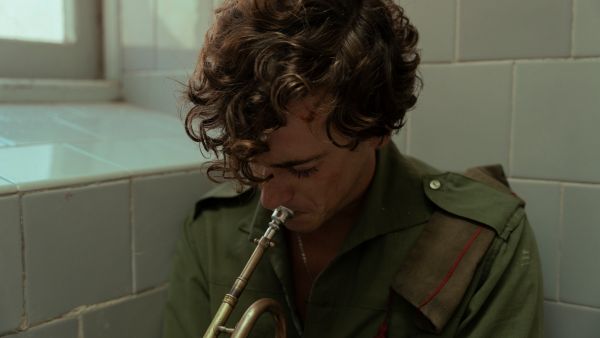

[…] of 2001: A Space Odyssey without Richard Strauss’s Also sprach Zarathustra? Would Nolan’s The Odyssey amount to only half of the grandeur it proposes without Ludwig Göransson’s score? Especially in […]