
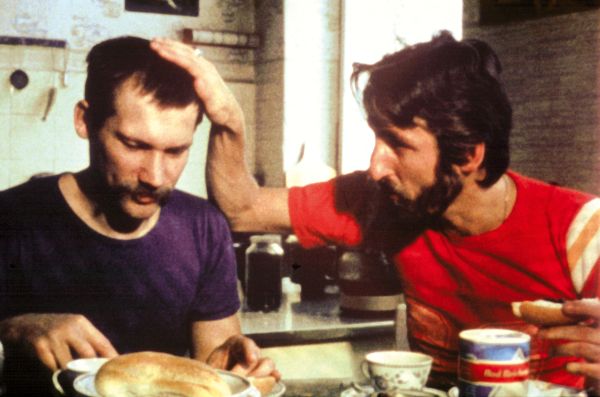
Writer/director Frank Ripploh’s newly restored autofiction film from 1980, set and released in the twilight just before the AIDS crisis, is a candid, complicated portrait of a grade-school teacher in West Berlin who restlessly seeks sexual gratification throughout the city while maintaining a fragile relationship with a movie theater employee. (Ripploh, using his own name for the character, plays, as he acknowledged, a version of himself.) For its unapologetic explicitness, unbridled feel, and non-judgmental lens, the film is considered a groundbreaking work of queer cinema and warrants reexamination, as well as the attention of new viewers.
The film wrestles with the conflict between private and public life. In the opening scene, Ripploh locks himself out of his apartment while nude, trying to swipe a newspaper from his neighbor’s mail slot. He knocks on her door, much to her surprise, and gets back into his place by climbing across her balcony. He then gets ready for his day at school: brushing his teeth in a spotty mirror, running out of toilet paper, washing himself with a hand towel, and dressing in a shirt and tie, with a ring of keys at his hip—all filmed cinéma vérité-style, messy flaws and all.
For his class, he asks his students to describe his morning after he wordlessly reenacts it, editing out the more unsavory details—being naked, stealing the newspaper. He also doesn’t mention flirting with a gas station attendant on the way to school (whose scrawled phone number is later discovered by a student in her class journal).
In his spare time, Ripploh frequents cruising spots in bathrooms, even grading assignments while seated in a glory hole stall, and plots his next escapades. Sometimes his plans are annoyingly interrupted by obligations, like attending a coworker’s birthday party. Ripploh is often the main character, controlling every scene. But at the party with his colleagues, he becomes almost a background figure, as the film shifts its focus to the faculty’s banal chatter.
Soon he meets Bernd (Bernd Broaderup) at a movie house. Bernd, with his neat handlebar mustache, short hair, and denim outfits, is sweet, down-to-earth, and docile—the opposite of Ripploh, who is bold and audacious. Fittingly, their first hook up takes place in an overly sudsy bath, a stark contrast to the grimy spaces Ripploh usually inhabits. We also see them frolicking in a snowy field in black leather coats, with Ripploh subversively disrupting the idyllic scene by pissing the shape of a heart into the snow.
This sense of purer, monogamous love is clearly not going to work for the two. While Bernd tries to take care of Ripploh—cooking for him, dreaming of seaside vacations and a life together on a farm—Ripploh, addled by the idea of domestic restraints, coziness, and a future of “rotting away” as a village schoolteacher, continues to sneak away for sex with others.
The film doesn’t hammer out moral judgments on Ripploh’s lifestyle. In that respect, it feels different from almost every queer film I can think of, where the story often revolves around a strong internal struggle about sexuality, such as coming out. Here, it’s more about the fractures between Ripploh and Bernd. No one is really wrong or right. They’re just wired differently.
The film mostly leans into its gritty, naturalistic style, but a few sequences are more stylized. An eerie, plaintive score plays as Ripploh drives alone through the rain-slicked streets of Berlin, the yellow headlights of his car nosing through traffic under the greenish glow of city lights. A certain complexity and sense of urban alienation emerges as Ripploh’s voice-over narrates his inner thoughts, admitting to his loneliness.
In a later scene, he sneaks out of a hospital—his liver ailing—and takes a taxi to a potential hook up in snowy woods near the bathrooms by Victory Column (a seemingly symbolic setting, also referencing the film’s title, translated as Taxi to the Toilet), as we hear the mechanical clicking of the fare ticking away. Again, the film explores what one does in secret, outside societal norms. That tension between private and public, the ordinary and the aberrant, collides in a great final scene, set in Ripploh’s classroom—a simultaneously joyous, raucous, funny, and bittersweet unraveling.






Leave A Comment