Anthology films are a rare and special breed. They can offer the satisfaction of an extended narrative with the excitement of beginning new ones, or, as in the case of Drunken Noodles, they promise a compelling portrait of a character in different situations and at different times. Part of the pleasure in them, regardless of what form they take, is in drawing connections between the assorted episodes.
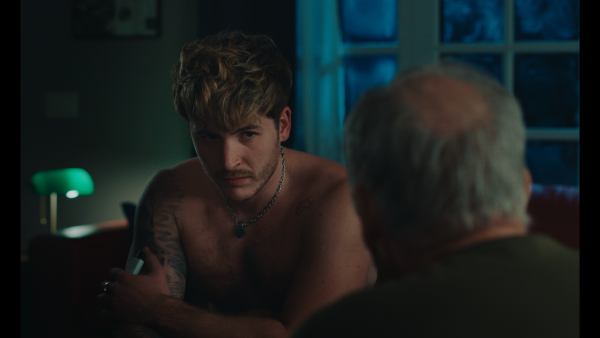
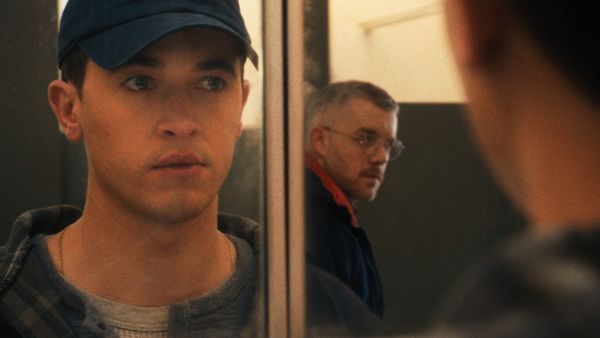
Each chapter here announces its title in embroidered letters, and all of them feature college student Adnan (Laith Khalifeh) at various points over two summers, out of chronological order. Each section deals, in some way, with both art and desire. In the first, Adnan begins a liaison of sorts with a food deliverer (Joél Isaac) while he interns at a Brooklyn art gallery. In the second, he meets an older artist (Sal Salandra), who opens his world to both sexual and mystical possibilities. This artist’s unruly embroideries of wild sex among satyrs and men are on display at the gallery in the previous chapter, where Adnan mentions he met the artist the previous summer. The third section finds him sharing a weekend getaway with his lover (Matthew Risch), a standoffish writer, and the fourth returns him to Brooklyn, where he has an unexpected experience wandering into McCarren Park to go cruising.
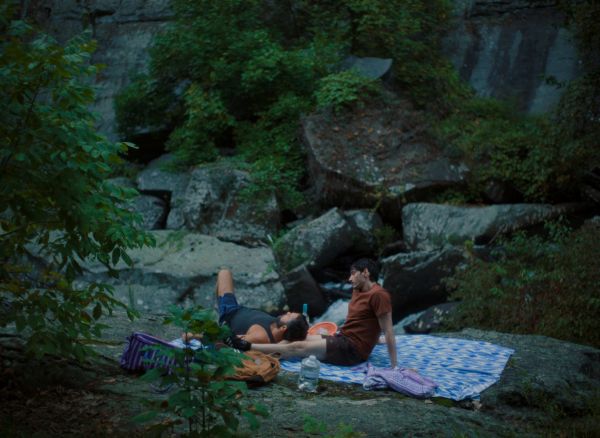
That drive-by of this 82-minute film might sound action-packed, yet the film’s chief strength is the way it captures Adnan’s ennui. Indeed, there are times this seems like a movie mostly preoccupied with waiting. The first chapter especially has a touching and poignant atmosphere, conveyed through the many moments of Adnan trying and failing to occupy himself, with the casual way sex simply arises between strangers in the park at night, and with the near-wordless departures afterwards. The conversation is also believably awkward. Much of the same is true of the third section, in which Adnan’s distance from his lover is especially palpable.
Unfortunately, the film also includes uncanny and mystical episodes, and there its hold is not so sure. Director Lucio Castro’s garish symbolism grasps too hard for profundity, is ill at ease with the film’s quiet tone, and is unconvincing in and of itself. There is, of course, no one way to create magical realism, and no one way to make a viewer surrender to a narrative’s freewheeling flow. In this case, the magic feels tacked on and vague—it is seldom given as much time to develop and thus feels silly. (The exception might be in the third chapter, which features Adnan’s lover’s doppelgänger.)
As the film progresses, it’s hard not to feel that there is, writ large, an uncertainty of purpose. How deeply do we know Adnan? How much of him is really explored? Withholding character traits can be very compelling. However, in this case, it comes across like a lack of imagination. By the end, the result feels much like an undercooked college project, which is a pity, since there are real flashes of beauty here and there.

Leave A Comment