
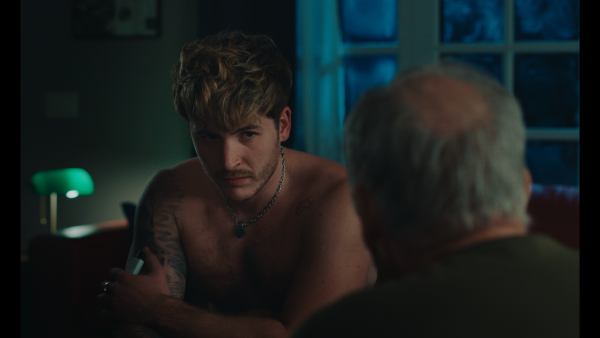
Elliot Tuttle’s debut film is daring both as a two-hander and in its sensitive portrayal of a pederast (the term the character uses to describe himself). The opening scene introduces Aaron Eagle (Kieron Moore), a late-20s, muscled, hairy-chested camboy, through one of his PornHub-type videos—with the occasional glitchy reception. As chat bubbles pop and animated tokens bling from his followers, he spouts the F-slur, demands his audience use poppers, shows off his ass, and acts with performative bravado. On the other end, we are introduced to Hank (Reed Birney), an older man donning a balaclava, watching Aaron on his laptop. The distance between these two men and the artificiality of the video will stand in dynamic contrast to what ultimately happens between them as the film unravels.
Online, Aaron agrees to Hank’s $50,000 offer to spend the night with him in a house in Los Angeles. (Hank has rented the house—an attractive, roomy, Spanish-style one where the majority of the film is set.) The strongest scene in the film is their first interaction there, where Hank begins recording Aaron, jeans torn at the knees, cocky, shirtless, and sprawled out on a sofa. A compelling power dynamic emerges that flips back and forth throughout: Hank stands, still ski-masked, looking down at Aaron and filming him while asking probing questions about his private life, including details of his first sexual experience.
The story shifts dramatically once Hank unmasks himself, revealing beady, dark eyes, quiet desperation, and nervous twitchiness. Now Aaron recognizes him. Hank taught at Aaron’s school when Aaron (whose real name is Alex) was 12 years old and was later convicted of the attempted sexual assault of a student. Because the dialogue reveals intimate character details and takes numerous turns that are often surprising, though never contrived, it’s best not to divulge too much more. Both characters take emotional journeys and, in one case, a somewhat physical journey as well.
Though Tuttle’s film is limited in setting, sometimes causing it to feel somewhat dull and repetitive, there’s often a subtle vibrancy to its filmmaking. Ryan Jackson-Healy’s cinematography utilizes the feel of different mediums, evoking the look of camcorders and webcams. The main titles sequence, eerily set to the cheery 1960s folk-pop tune “When Love Is Young” by the Free Design, features a little boy—perhaps suggesting Aaron—and looks like clips from a family movie. The title, hinting at the slang term for porno movies, becomes literal at times. The windows facing the night, along with the rooms of the house, often feel painted blue or drenched in blue lighting.
The film rides on a sense of directness and naturalism, as well as the magnetic, authentic performances by both Moore and Birney. Birney’s Hank comes off as both weaselly and tormented. (Hank mentions wrestling with his perversion, his existence, and his relationship with God.) He echoes Dylan Baker’s turn as a pedophile in Todd Solondz’s Happiness, a performance that has haunted me since I first saw it in the theater in the late ’90s. The role also showcases Birney’s gift for relaying internal struggles that seem perpetually on the verge of boiling over. (Birney also played the initially restrained father in Fran Kranz’s Mass, another film of limited settings centered around more outwardly emotive characters.) Even with a ski mask on, he remains quietly expressive through his voice and actions.
Within the narrative’s short time frame, it’s shocking to see how different Moore’s Aaron appears, with his brushed-forward, frosted blond hair, from the empty camboy exhibitionism of the opening to the final frames, where he ruminates over his past on the morning after. Both actors navigate these tricky characters with empathy and specificity, and they are Blue Film’s greatest strengths.



Leave A Comment