

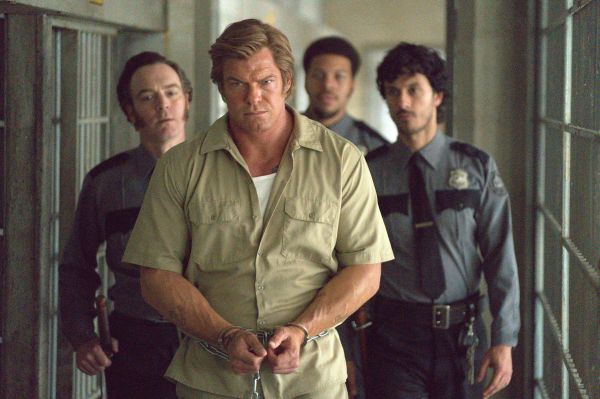
Army veteran Jeffrey Manchester was arrested in 1999 and convicted of two of an estimated 40-plus robberies of McDonald’s restaurants across North Carolina. Authorities dubbed Manchester the “Roofman” for his method of breaking into buildings by cutting through their ceilings. According to victims, he was a surprisingly genial robber—even offering coats to employees before herding them at gunpoint into restaurant freezers. In 2004, he escaped from prison and hid out in a Toys ‘R’ Us store in Charlotte, though he actually primarily lived in an adjacent vacant Circuit City. During this time, he occasionally ventured out in public, joining a Presbyterian church and starting a relationship with a single mother, Leigh Wainscott.
Derek Cianfrance dramatizes Manchester’s eccentric story with warmth and comedy, featuring charming turns from Channing Tatum as Jeffrey and Kirsten Dunst as Leigh. This marks a departure for the director, known for his gritty, dramatic works like Blue Valentine and The Place Beyond the Pines, but it still bears his signature hallmarks: specificity of place and nuanced performances.
The film introduces Jeffrey as a sympathetic figure: a divorced father and financially struggling veteran who turns to robbery out of desperation to provide for his children. After his prison escape, most of the action takes place in a store managed by the strict, no-nonsense Mitch (Peter Dinklage). Jeffrey hides in a walled-off area, sleeping on a makeshift bed (with period and thematically appropriate Spider-Man sheets) behind the bicycle section and using baby monitors to survey the store. The movie was shot in an abandoned Toys ‘R’ Us in North Carolina, re-created to reflect its 2004 setting. Cleverly, Jeffrey hacks into Mitch’s computer system, disabling the overnight security cameras. This allows him to roam the store after hours for food, namely peanut M&Ms and baby food, and to wash himself in a bathroom sink.
As the Roofman story fades from the local news, Jeffrey begins venturing out in public again. He changes his name to John Zorn, pretending to work for the government, and starts dating Leigh, one of the store’s employees, after meeting her at church. He gradually ingratiates himself into both the congregation and Leigh’s family. She is a recent divorcee with two children: sweet tween Dee (Kennedy Moyer) and angsty teen Lindsay (Lily Collias). The long separation from his own children weighs heavily on Jeffrey. He takes on Leigh’s kids as his own, trying to spend time with them while also gifting them stolen items. As a lucrative hustle, he steals PlayStation games to sell them at a pawn shop. Meanwhile, he awaits the return of his best friend, Steve (LaKeith Stanfield), who is due back from serving in Afghanistan. Jeffrey hopes Steve can help him create a fake passport to leave the country.
Roofman could feel like a convoluted story were it not based on real events. With its slightly mawkish voice-over narration from Tatum, the film occasionally feels a little too sanitized. Some side characters are underwritten, particularly Mitch, who functions mostly as a villainous micromanager, though Dinklage does his best to keep it from becoming too cartoonish. Still, I felt swept up in the story and its vivid use of North Carolina locations—from the fluorescent brightness of the Toys ‘R’ Us to the cheerful inquisitiveness of women from the church at a Red Lobster singles event. Themes of American consumerism and incarceration are threaded throughout with a light touch.
The film wouldn’t work nearly as well without Tatum and Dunst and their palpable chemistry. There is something unsettling about Jeffrey’s rampant duplicity, but embodied by the charming Tatum, he’s amusing and oddly sympathetic. It’s a wide-ranging performance, spanning comedy and drama, with moments of physicality and glee—one moment finds him sliding across the store’s floor in neon shades, Risky Business–style; in another, Mitch catches him naked in the store, and Tatum sprints and leaps into his hidden crawlspace. Dunst provides the emotional gravity. At times, I wondered if she was too good for the material. She embodies Leigh’s mix of silliness, longing, and creeping suspicion with naturalism and nuance. This includes a mascara-running crying scene that feels fresh and authentic. She embodies this character completely.
The film makes a mistake by overexplaining and leaning too much into the real Jeffrey Manchester with photographs and videos in its end credits. Otherwise, with its twisty story, two standout turns, and rich atmosphere, Roofman is an absorbing tale of a unique fugitive.








Leave A Comment