
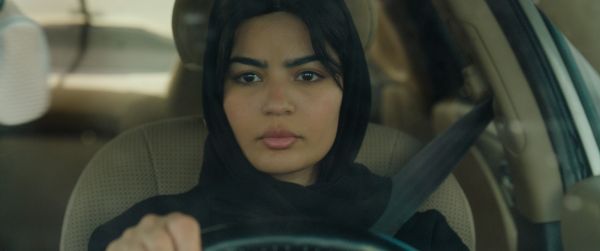
If you are jonesing for a good noir murder mystery, in this case set in Saudi Arabia, you’re in luck. Unidentified has arrived.
Nawal (Mila Al Zahrani) has left her family and her hometown after a humiliating divorce and now works as a clerk scanning old files at a police station in Riyadh. She is hooked on online true-crime webcasts, which she constantly listens to on the job. Her life is exceedingly routine but exhilaratingly her own.
One afternoon, her supervisor, Col. Majid (Shafi Al Harthi), asks her to look over a case. The victim, a teenager, has apparently been dumped in the desert. Majid thinks Nawal, as a true-crime enthusiast, might be able to notice something his male colleagues missed. And, indeed, that’s just what happens. Not only that, she begins obsessing over identifying the victim, which causes her to start investigating on her own, leading, of course, to a heap of trouble.
As a woman in Saudi society, she is simply able to go places and earn trust that men can’t. More importantly, she susses out motives that her male colleagues can’t because they are, willfully or not, blinded by their biases. In a meeting at the police station, Nawal overhears the investigators conclude that the young woman’s death was an honor killing. Nawal instinctively knows this doesn’t add up. She brings her concerns to Majid, who takes her advice but cautions her not to continue investigating, as it may ruffle feathers. Fat chance.
Director and co-writer (along with Brad Niemann) Haifaa Al-Mansour contrasts these scenes with the desolation of Nawal’s personal life. She lives in a dull, dreary apartment, plagued with grief and nightmares. Even after she unpacks, her apartment is sparse and depressing.
After pinpointing what private school the victim attended, Nawal follows two students to a hookah bar where young women go to enjoy themselves before being shuffled off to arranged marriages. Each step the would-be sleuth takes not only gets her closer to the truth but exposes the effect of oppressive laws and mores on not just women but everyone.
Al-Mansour (Wadjda, The Perfect Candidate) occasionally hammers this theme home, but mostly allows for quiet observation to clue us in. Simply watching when and where Nawal covers her face with her niqab and when she decides to uncover herself gives us an idea of what she has to navigate. The most compelling aspect of Unidentified is how Nawal takes advantage of her status—or lack thereof—as a woman, a divorced one no less. Nawal is able to lurk unnoticed to overhear conversations in the police department and wrings admissions from people by flipping the script. It’s fascinating to watch her code-switch.
The working relationship between Nawal and Majid is utterly charming. Majid is the only male colleague who shows any interest in or deference to Nawal. He is impressed by her investigative skills and also by her drive. In an amusing exchange, Nawal explains how she would get away with murder, and Majid is amused by and admires her ruthlessness.
There is a late twist ending that would not work in a lesser film, but Al-Mansour peppers hints throughout, and it completely falls in line with her general theme of how women here have to circumvent rules to get what they want.
The film is shot, for the most part, rather perfunctorily. In its bones, it is a procedural, but occasionally a breathtaking and beautifully composed shot occurs as if a flower has burst from concrete. As if beauty can be pulled from the harshest of places and circumstances, which, again, is of a piece with the intention of Unidentified.


Leave A Comment