
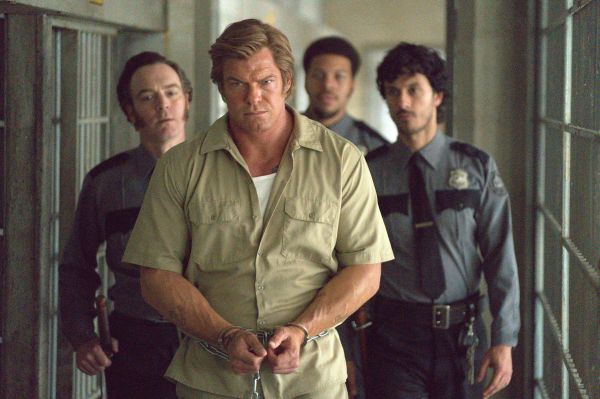
Alan Ritchson has been a working actor for over 20 years, but it wasn’t until Prime Video’s Reacher that Hollywood finally started recognizing him as a Next Big Thing. Three seasons of television later, it’s not hard to understand why. With his 6’3” height and massive build, Ritchson knows how to convey a physically intimidating presence and perform badass stunts without saying a word. Motor City, a new 1970s-inspired crime thriller, takes that demeanor and runs with it to a logical extreme, telling a story nearly devoid of dialogue with frustratingly mixed results.
This is certainly a genre that plays to Ritchson’s strengths, allowing him to look and emote the part of wronged man John Miller out for revenge with bloody results. However, Motor City’s central gimmick—conveying its story through little-to-no talking and plenty of needle drops—begins to reveal cracks midway through, often at the expense of characterization or a deeper narrative.
An ex-veteran factory worker living in ’70s Detroit, Miller seemed to have things going up for him. He’s been discharged from probation, managed to recover his car from thieves, and intends to propose to his longtime waitress girlfriend, Sophia (Shailene Woodley). That’s when the police unexpectedly break down his door, arresting the blue-collar Miller for drug possession in a way that lets you know someone set him up to be a fall guy. As it turns out, that someone is Reynolds (Ben Foster), a shady criminal who also happens to be Sophia’s ex. A flashback reveals how their breakup doubled as the night she and Miller first met, a slight Reynolds never forgave, and he has now seized the opportunity to ensure the latter is out of the picture for good.
Sending Miller to prison, Reynolds uses his absence to win Sophia’s heart again and subsequently torture the incarcerated innocent man—placing love and revenge at the very top of Miller’s mind. There’s also a dirty cop (Pablo Schreiber) who plays a role in Miller’s imprisonment, as well as a more ethical officer (Benjamin McKenzie) who suspects something is amiss and tries to investigate further. All this leads to a daring prison escape, followed by tragedy and eventually a climactic shootout with fists and buckshot aplenty.
The plot is at once accessible and beside the point. It’s rudimentary Grindhouse-influenced revenge movie storytelling, with the catch being director Potsy Ponciroli’s commitment to a near-wordless depiction of events. When it’s not Steve Jablonsky’s original score, you’ll regularly be listening to classic ’70s songs straight out of James Gunn’s favorite soundtracks. But while the movie looks and feels gritty, these musical bits come off like a double-edged sword. They might set the initial mood, but eventually these scenes keep going past the point of necessity—seemingly because the accompanying song needs to finish playing before moving on. This happens far too frequently, to the point that the sound design tends to overshadow the plot’s stakes rather than enhance its emotional core.
This doesn’t stop Ritchson—or the many distracting wigs he wears—from providing just enough emotional glue to hold this story together. Compared to Reacher and other recent projects, Motor City allows him to show a bit more vulnerability as an average Joe thrown into horrifying circumstances without losing the ferocity behind his eyes. That is especially true when the man is finally allowed to cut loose and kick ass. The rest of the cast are saddled with far less to work with, though Woodley and Foster still do their best as the dream girl and scummy antagonist. When characters eventually speak, it feels akin to title cards from old silent films: unexpected, somewhat poignant, but secondary to the physical nature of their performances. Overall, this nonverbal presentation isn’t quite as underwhelming as John Woo’s Silent Night, but it never reaches the visual brilliance of Hundreds of Beavers either.
It’s only once Motor City reaches its exploitation-style final act that Ponciroli delivers on what viewers wanted to see. Here, the wordless storytelling blends in more naturally with fiery action set pieces, and it’s great fun watching Ritchson blast his adversaries while delivering one particularly satisfying elevator beatdown. Here, the fists and firepower do the talking, and it oddly gets the point across better than several dramatic montages. Otherwise, however unique its audio-visual take on a familiar genre seems at first, Motor City can’t help but fall back on old clichés.




Leave A Comment