
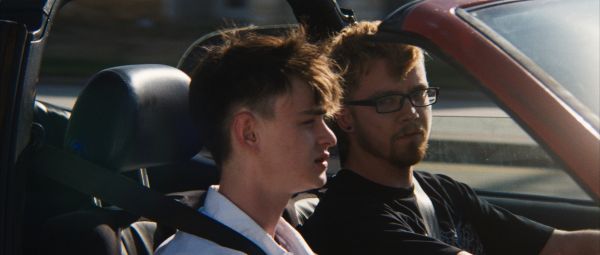
How, in an internet landscape ridden with AI and social media avatars, can we tell the difference between the real and the fake? And what, in this age of isolation and the male loneliness epidemic, are all the sad young men up to? These are the questions driving this new film, which begins with Balthazar (Jaeden Martell), a super-wealthy teenager, recording a video of himself wailing about his sadness from his high-rise apartment. As soon as he’s done, his tears are gone. He posts the video to social media, where the likes and comments promptly roll in. It’s hard not to conclude that these were crocodile tears, to some degree. And yet, a boy who is moved to do that in the first place must be no stranger to loneliness. One of the first things we learn about his mother (Jennifer Ehle) is that she’s going away for his birthday weekend, leaving him on his own.
Balthazar’s relationship to the internet takes a new turn when he develops a crush on Eleanor (Pippa Knowles), a classmate who is fiercely dedicated to protesting gun violence. (He discovers this at an assembly where an instructor leads the students through a simulation of a school shooting.) His attempts to win her affections are, shall we say, misguided: He hits on her while pulling up a video of a recent shooting in Arkansas. His failure, however, leaves him no less dedicated to winning her heart by demonstrating his engagement with her chosen cause.
When he receives a direct message from an online stranger who claims to be an aspiring school shooter, Balthazar dedicates himself to saving this person and preventing a massacre, even if it means baiting him with AI-generated promises of sex and flying to Fort Worth to meet him in person. As it turns out, Solomon (Asa Butterfield), the young man on the other side of the chat, was not presenting an entirely truthful portrait of himself either.
The more this film progressed, the more I realized its premise really had potential. The levels of lying, of misconception, and of the gaps between performance and reality are especially promising when the two boys meet. The emotional world of lonely and isolated teenagers, who might otherwise be written off as incels, could be very rich. I was especially compelled by the director’s decision to force two teenagers from completely different worlds to deal with each other.
The problem is that, writ large, the film has no idea what it’s doing. If the chosen subjects are bold and contemporary, one finishes the film with the impression that the director read a bunch of articles about lonely youth rather than engaging with them. In Solomon’s case especially, his backstory is contrived, relying so much on staple subjects (trailer park poverty, toxic masculinity, daddy issues, sexual rejection) that it’s hard not to feel like the filmmaker was as distanced from his characters as they are from each other when they initially connect online.
The story lurches from twist to twist, but the impression is not of an artist in control of a wild and crazy plot, but of one wantonly jolting his characters this way and that for the sake of the story. Climactic acts of violence feel obligatory—the principal characters try to be friends only because that’s what the filmmaker needs them to do. Balthazar is also such an obtuse character that he strains believability, and I was often struck by the film’s failure to embrace, or even recognize, the absurdity of its characters’ decisions. Instead, the film aspires to realism, but I didn’t find it all that believable that Solomon indulges Balthazar even after discovering he’s been catfished. I could go on.
Shock value is what we’re left with at the end, but the hand at the wheel never leads us into either shocking or poignant territory.






Leave A Comment