
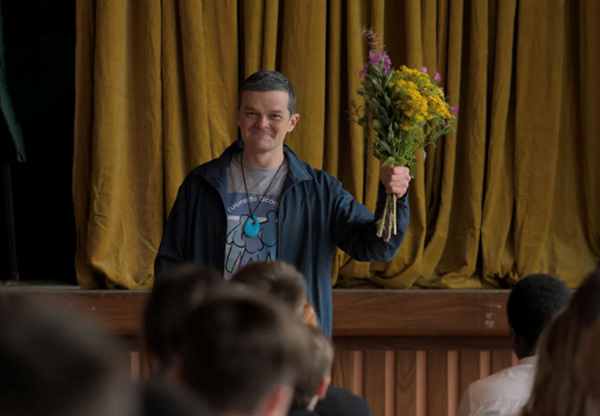
Writer/director Kirk Jones, known for comedies like Waking Ned Devine (his debut), Nanny McPhee, Everybody’s Fine, and My Big Fat Greek Wedding 2, infuses his latest with charm and spirit. The opening of this occasionally stirring biopic of Tourette syndrome activist John Davidson establishes its tone right away, when John (played affectingly by Robert Aramayo, who won a Best Actor BAFTA award for his performance) shouts out “Fuck the Queen!” at a 2019 Member of the Order of the British Empire awards ceremony with the queen herself. It’s somewhat of a corny setup, reminiscent of Tom Hooper’s hackneyed, if moving, The King’s Speech. This mix of contrasting staid environments with humorous touches is overall effective, despite the film setting up John’s coprolalia—his neurodevelopmental condition—as comic fodder a little too often.
It begins in 1985 when John (here played wonderfully by Scott Ellis Watson, in an impressive film debut) is a 14-year-old first-year at a posh preparatory school. (New Order’s “Blue Monday” plays over the soundtrack, one of many iconic British rock touchstones that figure throughout the decades-spanning story; its repetition of the lyric, “How does it feel?” is perfect for what the film portrays).
The symptoms of John’s Tourette’s first appear while he’s reciting a passage of Yeats out loud in class, his teacher and classmates perplexed by John’s tics and unusual accenting of words. This continues at the dinner table at home to the great bewilderment and disdain of his father, Steven (Steven Cree), and mother, Catherine (Shirley Henderson). She becomes so upset by his tics and outbursts that she forces him to sit on the floor at every dinner, facing the fireplace where he can spit food during his involuntary compulsions. Additionally, a soccer scout passes on John, once a promising footballer, as a prospect, confused by his erratic motor skills. These scenes of John as a young adult and the teasing, wrath, and misunderstanding he endures from peers and adults—including a schoolmaster who whips John’s hands—are some of the movie’s most wrenching moments.
His story takes on a new beginning in his early twenties (Aramayo takes over the role from here on out). John’s mother has been taking care of him on her own, John’s father having long abandoned the family. They have settled into a routine of errands and grocery store trips, and their relationship seems wearied and strained—she has John on heavy medication (Haloperidol) and is visibly worn out and exasperated by him. An old schoolmate’s mother, Dottie Achenbach (Maxine Peake), is sympathetic to John’s needs and soon takes him in to live with her family. Gradually, she tries her best to help John establish his independence—to go out dancing at a bar, to have a job (as a community center custodian under the mentorship of a crusty, salt-of-the-earth, though empathetic, caretaker, Tommy, played by Peter Mullan), and eventually, to live on his own. These attempts at adulthood do not always go well, sometimes failing spectacularly through arrests and hospitalizations, but John slowly carves out a life and purpose of his own.
Both Watson and Aramayo give vibrant and moving performances that never feel false or like caricature. Peake and Mullan are lovely, and the warm presence of their characters provides an anchor in the film, especially when so much for John often goes wrong. Even though she doesn’t age believably throughout, there’s a sad brittleness to Henderson’s Catherine that lingers.
The film illuminates aspects of living with Tourette’s that many may not know about, especially when it features non-actors with Tourette’s working with John during the outreach, education, and advocacy stage of his life. Here in this latter half, the tone veers from a straightforward narrative into more of a message movie. The pace quickens and the handsome, moody photography by Graeme Hunter becomes brighter. Since this subject matter is so rare in film, it remains a winning and moving effort.





Leave A Comment