
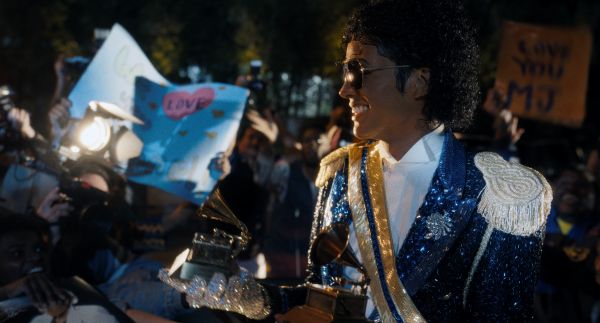
In recent years, musical biopics have grown more creative in their storytelling thanks to entries like Rocketman and Better Man. Even last year’s Springsteen: Deliver Me from Nowhere eschewed the usual formula (the early years of struggle, stardom, and mid-career downfall) in favor of something far more introspective about its subject’s emotional state. Michael, the hotly anticipated Michael Jackson film, attempts to channel a bit of the latter in its DNA despite clinging to old tropes. But those tropes remain prevalent in how the filmmakers grapple with the pop icon’s legacy, focusing specifically on Jackson’s unprecedented rise to stardom rather than the controversial figure he would later become.
This push and pull between examining Jackson’s origins and maintaining his image forms the dichotomy of Michael’s production. Although director Antoine Fuqua handles the visuals and pulse-pounding set pieces quite well, one can’t help but wonder how much oversight the Jackson estate had on this script. As a result, the movie is torn between two worlds, going big when it wants to dazzle the audience with Jackson’s greatest hits but playing it safe otherwise.
Where most musical biopics transition from a star’s childhood to their breakout success, Jackson’s eras are forever intertwined. Michael kicks things off in 1960s Gary, Indiana, with young Michael (Juliano Valdi) and his brothers preparing for their earliest musical gigs at the behest of their demanding father, Joe (Colman Domingo). For the senior Jackson, these performances are the family’s ticket out of obscurity. He insists the brothers practice constantly and puts Michael’s voice front and center, while also beating him for disobedience. His “winners and losers” mindset initially bears fruit and cements the Jackson 5 as a breakout band, later capturing the attention of Motown. From there, it’s hit after hit for the family, earning them a life of fame and fortune but depriving Michael of the childhood he craves.
This section is where the musical formula is most noticeable. We’re treated to montages of early Jackson 5 hits like “ABC” topping the charts, long nights of practice, and family members and recording artists assuring Michael that he’s destined for greatness. Even upon reaching adulthood (played by Jaafar Jackson), Michael’s star continues to rise after he releases a solo album, albeit during his off-hours and under Joe’s thumb. Yet there are traces of interesting character development—such as the scene where Michael seeks a nose job that highlights the ingrained trauma of his father’s emotional abuse—Joe had regularly criticized Michael’s nose for not being symmetrical or photogenic.
Once Michael hits its back half, it develops a more confident rhythm, with Jackson recruiting entertainment lawyer John Branca (Miles Teller) to help him become an independent artist. The musical hits still pile up, taking us through the making of “Beat It,” “Thriller,” and “Billie Jean.” These moments are certainly nostalgic, but Fuqua—who got his start directing music videos—knows how to make them feel distinct. Even if you have listened to those songs a hundred times before, watching Michael develop the rhythm and aesthetic for each performance is a clever way to underline how the star embraced a cinematic approach to music videos. Picking Jackson’s nephew to play his ‘80s self might be blatant stunt casting, but his performance feels genuine. The way Jaafar dances doesn’t feel like a mere imitation of his uncle, but more like Michael’s ghost possessing Jaafar while spinning and moonwalking.
Playing opposite Jackson is Domingo, whose performance reflects a greedy ambition to promote and preserve the Jackson brand at the cost of Michael’s independence. Joe wants his son to be successful, but only to the extent that he can claim credit for that success. Michael, as his father sees it, must honor that commitment to family performances or be strong-armed into obliging his whims. This custodial treatment, which Domingo plays as cruelty masked with charisma, is framed as the source of Michael’s obsession with childhood: his love of Peter Pan and Neverland, living in a bedroom filled with Disney memorabilia, or adopting animals to live on his estate. To the same extent, it explains why he is far more comfortable around children than adults—a point that cannot help but remind viewers of the sexual abuse allegations that later tainted Jackson’s stardom.
Michael will appeal to those who love his music and remember the King of Pop’s golden years, and on that note, the movie succeeds. However, it deliberately locks Michael Jackson’s story in a point in time where viewers don’t have to ask any tougher questions about his life and flaws. All that’s left is a 1980s untainted, sanitized version of the singer that, in its own way, feels like a real-life version of Michael reaching Neverland.





Leave A Comment