
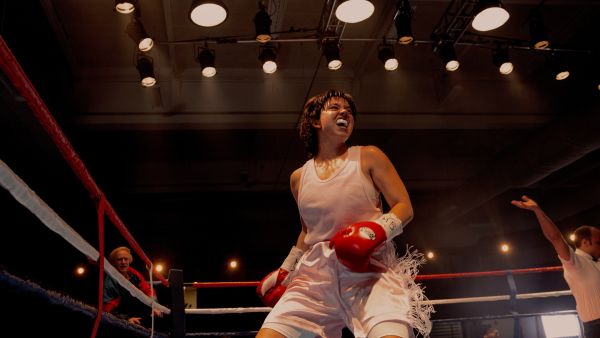
Contact sport movies are a dime a dozen, but Christy Martin’s remarkable true story helps make David Michôd’s biopic a compelling watch. Short and unassuming in stature, but capable of landing jabs with ferocious precision, Christy (a convincingly against-type Sydney Sweeney) begins her career while in her early twenties in 1989 in her native West Virginia, winning a string of matches. A local notices her raw talent and introduces her to Jim Martin (Ben Foster), a trainer in Tennessee. Jim is dismissive at first of the idea of a “lady boxer,” but after seeing Christy knock out a guy twice her size in practice, he immediately recognizes her potential, taking her under his wing.
Jim, with a straw-blond combover, honeyed southern drawl, and tacky, ill-fitting tracksuits, is quietly controlling from the beginning. He tells Christy what to eat, how to wear her hair, and meddles in her personal life. He disapproves of her lesbian relationship with hometown girlfriend, Rosie (Jess Gabor), and befriends, and perhaps colludes with, Christy’s judgmental, passive-aggressive, homophobic mother, Joyce (Merritt Wever). When Jim gifts Christy a pink boxing outfit, it is not out of kindness, but as a way to feminize and control her image. The two begin sleeping together—not out of attraction on her part, but perhaps out of desperation or being controlled. Partly because he promises financial stability and the furthering of her career, she begrudgingly accepts Jim’s marriage proposal. The couple then moves to Florida for a new start.
Once there, she eventually meets Don King (an uncanny and blazingly funny Chad Coleman), the prominent American boxing promoter. Impressed by her scrappy attitude, he gives her a contract and nicknames her the “Coal Miner’s Daughter.” Her career skyrockets, and she becomes the first female boxer to be featured on the cover of Sports Illustrated. Yet, as Christy’s prominence soars, Jim’s jealousy and drug use spiral into physical abuse.
In biopics of this type, there is always the inevitable downfall, which is where the movie begins to lose its sense of momentum. Still, something so awful happens to Christy later on that it is impossible not to be riveted, especially since the performances by Sweeney and Foster are so absorbing. It may have been a benefit to go in not knowing Christy’s story, since the agonizing incident toward the final act is almost unbearably intense. (It still worked for a subsequent watch, but to a lesser degree.)
Both Foster and Wever are the highlights, imbuing their unsympathetic characters with chilling detail, even if they sometimes veer into theatricality. As someone from the South who has heard a lot of dreadful accent work in movies, it is refreshing and surprising to hear Wever nail down a specific tone, tenor, and affect so well. When Christy comes to her mother asking for help from Jim’s abuse, she responds with a high-pitched, slowly delivered, “bless-your-heart” kind of dismissiveness and blame that is thrown right back at Christy. It may seem a surprising or over-the-top reaction to some, but for those who understand where Christy comes from, it is all too familiar.
As fighting nemesis Lisa Holewyne, Katy O’Brian (also memorable as a domineering athlete in Love Lies Bleeding) brings a sense of naturalism as a colleague who becomes one of Christy’s biggest and most unlikely emotional supporters. The same goes for Gabor’s Rosie, who reemerges later in the timeline with compassion and resolve. Perhaps having the monsters of the story be played with a dash more showiness in comparison to its quiet heroes is what makes the film unexpectedly effective and moving.
Throughout, Sweeney bridges both sensibilities of theatricality and naturalism. At times she is overshadowed by the supporting players, yet her heart-on-its-sleeve performance lands powerfully, especially in the wrenching latter half. (She gained 35 pounds and trained extensively for the role.)
The production values (notably the wigs) are imperfect, the boxing scenes sometimes lack dynamism, and the script is not necessarily groundbreaking. Yet, like its subject, Christy is a scrappy, rough-edged indie that you want to root for.





Leave A Comment