
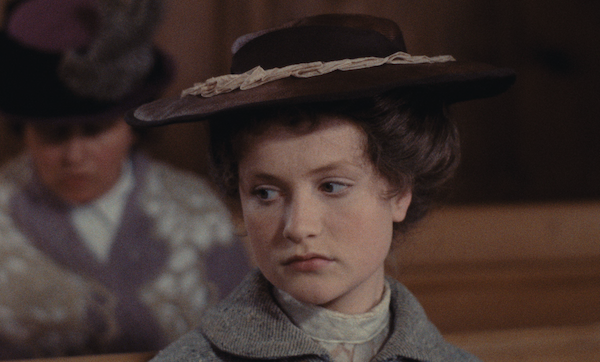
Watching Liliane de Kermadec’s 1975 biopic about Aloïse Corbaz—the subject of a beautiful 4K restoration—is like engaging in an act of artistic reclamation. De Kermadec, today a barely known French director, began as an assistant on films by Agnès Varda and Alain Resnais and made several features and shorts before her 2020 death at age 91. Corbaz, a self-taught Swiss artist who belonged to the outsider art movement, is likewise little known.
Born in Lausanne, Switzerland, in 1886, Aloïse Corbaz (played by Isabelle Huppert as a young woman and Delphine Seyrig as an adult) wants to become a singer. Although her father (Marc Eyraud) objects, she is able to take some formal lessons but leaves for Germany after high school graduation to work as a governess. Once World War I begins, she has to return to neutral Switzerland, where in 1918 she is committed to a psychiatric institution by her family and diagnosed as schizophrenic after the intensity of her religious and pacifist feelings leads her to start accosting strangers on the street. She remained in the asylum until her death in 1964.
Aloïse’s artistic interests were often treated with condescension. At her high school graduation, she earns praise from the female administrator for her writing and musical skills, as well as French, German, English, and history, but is told her grades in sewing and home economics—two subjects a future wife and mother should be expected to excel in—are lacking. Even her voice teacher (Roger Blin) tells her that she will forget about singing once she leaves provincial Switzerland and sees the outside world.
Upon Aloïse’s return home, de Kermadec portrays the young woman as irreparably damaged by a restrictive society, rather than—as in real life—including her unending obsession with Germany’s Kaiser Wilhelm. Perhaps the director omitted that fact out of tact, believing that such a trigger would be too bizarre for contemporary viewers to comprehend. Nevertheless, watching her slide toward confinement as if it were inevitable is quite powerful. The rest of the film looks unblinkingly at the horrors of her institutionalization and how doctors—some sympathetic, others not—generally saw her and the other patients as little more than guinea pigs for various treatments.
Although de Kermadec is more concerned with her protagonist’s long-term asylum stay, she does feature her creating her remarkable and ravishingly colorful drawings of beautiful women with military men (likely allusions to her beloved kaiser, although the film does not make that link). Her talent as an artist is recognized. Later in life, she visits a gallery where several of her works are on display, about which she amusingly but seriously remarks, “What was ugly has become beautiful.” On the other hand, an art professor who leads an examination of her works describes them as “art of the delusional mind,” although he appreciates her artistry even as he makes jokes about her in front of his all-male class.
De Kermadec’s straightforward direction never sensationalizes her subject, even during several disturbing sequences concerning the asylum’s patients acting out the behaviors that caused them to be confined. That directorial nuance is underlined by her stars, Huppert and Seyrig, who give understated but searingly effective performances as two parts of a woman whose artistry and uniqueness were stifled but not completely erased.





Leave A Comment