
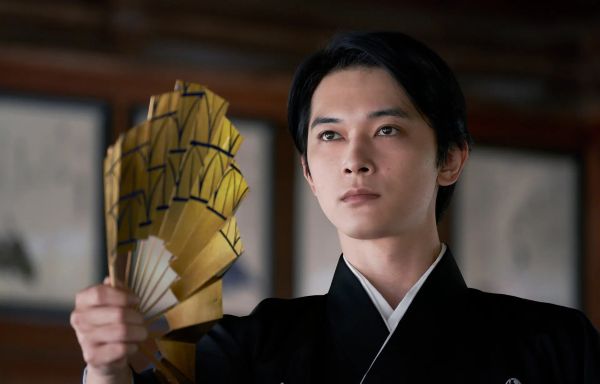
Spanning 50 years, Sang-il Lee’s sweeping yet intimate film follows two men from childhood through the ups and downs of adulthood as they become notable kabuki performers. Based on an epic 2018 novel by Shuichi Yoshida (an English translation of which does not appear to have been published), the film harbors both a modern sensibility and the thematic aspects of ancient storytelling and folktales: the trials and tribulations of clashing brothers (one a blood relative, the other not) or of an artist who seems to sell his soul to the devil for greatness.
The atmospheric opening sets the tone for what follows. Fourteen-year-old Kikuo (Soya Kurokawa as the child; Ryo Yoshizawa, in a remarkable turn, as he enters his twenties and onward) is a gifted onnagata—the term, originating in the 17th century, for male actors who play female roles in kabuki theater—performing for a small gathering in his hometown, Nagasaki, in 1964. A visiting guest and audience member, Hanai Hanjiro II (Ken Watanabe), is enchanted by Kikuo’s performance, particularly impressed by his command at such a young age. Shortly afterward, amid a beautiful snowfall on a still, bluish night, Kikuo’s father, a prominent organized crime boss, is attacked and murdered, a killing Kikuo witnesses.
The story jumps ahead a year to where Kikuo, after unsuccessfully attempting to avenge his father’s death, is sent to live with Hanai in Osaka to train alongside Hanai’s son, Shunsuke (Keitatsu Koshiyama as a child; Ryusei Yokohama as an adult), deepening their onnagata skills under Hanai’s strict tutelage. On the periphery, Hanai’s wife, Sachiko (Shinobu Terajima), disapproves of Kikuo’s yakuza lineage and of Hanai’s encouragement of Kikuo’s skills, particularly because Kikuo is not her son.
At first, Hanai is hard on Kikuo, demanding that he hold and twist his shoulders and body at angles that look nearly impossible. Over time, however, Kikuo becomes a kind of stepson, with his talent and dedication to kabuki slowly eclipsing Shunsuke’s. As the two grow as popular performers together, the power dynamics and emotional closeness between them shift in compelling, often unpredictable ways.
With its sprawling story of a fitful brotherhood at its center, Kokuho is often a film of ravishing beauty. For those, like me, unfamiliar with—or having only a surface-level understanding of—kabuki, the filmmakers present an illuminating, reverent portrait. The performance sequences are masterfully captured across every technical element. Elements of sound design—from the strained falsetto registers of the dramatic onnagata performances to Marihiko Hara’s percussive score—are often disconcerting and unsettling rather than lilting and sonorous. Time seems to stop in these moments, creating a state of meditative tension.
The lavish stage sets and costumes are striking, as are the faces of bone-white makeup, red lips, and red-rimmed eyes. (The film received a surprise, though well-deserved, Academy Award nomination for Best Makeup and Hairstyling.) Perhaps in purposeful contrast to the drabber olive and gray tones of Kikuo and Shunsuke’s everyday clothes, many of the non-performance scenes are captured with less noticeable panache. Sofian El Fani’s cinematography, sweeping and grand in the performance scenes, becomes much more still and quietly illuminating in others, lingering on faces and eyes. (El Fani has helped craft similarly alluring visual portraits in the Northern France bohemia of Blue Is the Warmest Color and the deserts of Timbuktu).
The performances are all impactful, but there is something extraordinarily rich about Yoshizawa’s contrasting dispositions as Kikuo. Out of costume, he can be opaque, somewhat chilly, and ambiguous; in his elaborately costumed onnagata performances, he reaches precise and gut-wrenching emotional crescendos. Kikuo is quietly yet ruthlessly intent on becoming the best performer in Japan, but his reasons for doing so aren’t always spelled out—often it seems he’s masking the pain of losing his father.
Perhaps because of its enduring, intergenerational themes and rich visuals, the nearly three-hour film is a sensation in Japan, becoming the top-grossing Japanese live-action film of all time. One hopes it will attract attention here as well, especially in a theatrical setting, as a classical, enigmatic, and distinctive picture.



Leave A Comment