
If film allows us to travel through time, it does so not just through images, but also through the ideas embedded in a particular place and moment in history. Rather than functioning like a time machine, cinema is more like amber: capturing and preserving a fragment of the present for posterity—even when it seeks to re-create the past or imagine the future. These fragments are open to reinterpretation, allowing for new meanings that can reframe their original focus or intent.
In Caught by the Tides, one of the most impressive cinematic experiments of the decade, Jia Zhangke pushes the boundaries of how far movies can play with time and generate new meanings. In his latest work, the acclaimed Chinese director—whose films have been featured and awarded at the world’s most prestigious festivals—confronts, in part, his own legacy. But this is not an exercise in nostalgia; it’s a search for a creative path forward. Technically, the film was conceived and shot linearly over more than 20 years, in parallel with the eight other films Zhangke released during that period (from Platform to Ash Is Purest White). It was completed after the Covid pandemic, with final images directly tied to that particular moment in our collective history. Ultimately, the film chronicles two decades of contemporary Chinese life in the early 21st century—particularly in the northern city of Datong—through a hybrid form in which the boundaries between fiction and documentary blur, even collapse.
Zhangke recycles footage from his earlier films and salvages old outtakes to create something wholly new, telling stories that diverge from those originally tied to the images. In doing so, he also reconfigures past performances by his actors, blending them with recently filmed material. Frequent collaborators Zhao Tao (his wife) and Li Zhubin play Qiaoqiao and Bin, lovers separated by diverging ambitions and reunited years later in a state of disillusionment.
The couple’s aging process feels deeply real and natural—because it is real. The actors have aged over two decades in their collaborations with Zhangke. Though the execution might sound disjointed, the final result achieves narrative and emotional coherence. The closest cinematic parallel might be found in Richard Linklater’s projects—like the “Before” trilogy, Boyhood, or his ongoing adaptation of Merrily We Roll Along. The key difference is that, aside from its final act, Zhangke’s film feels more like an accidental marvel: a constellation of images and performances that have existed for years, waiting unknowingly to become part of something new.
The plot is simple: a woman searches and waits for the man she loves amid the social and technological upheavals of a country where progress is unkind to those left behind. At the turn of the century, Bin leaves to try his luck elsewhere, while Qiaoqiao is left with the promise of his return once he has made his fortune. A few messages are exchanged—texts and voicemails from the pre-smartphone era—but distance wins out.
To focus too much on the narrative is to miss the point. The film’s power lies in the immersive experience of watching it—being absorbed by its images and, just as crucially, by its music. The interplay between cinema, music, and performance transforms Zhangke’s experiment into a visual symphony of 21st-century China: an opera of quiet solitude and frustration contrasted against the relentless noise and motion of a landscape in flux. From ballrooms to coal mines, it’s a mosaic that glimpses displaced communities and even portends the rise of AI. Instead of arias, we hear an eclectic mix of metal, techno, pop, rock, and traditional singing.
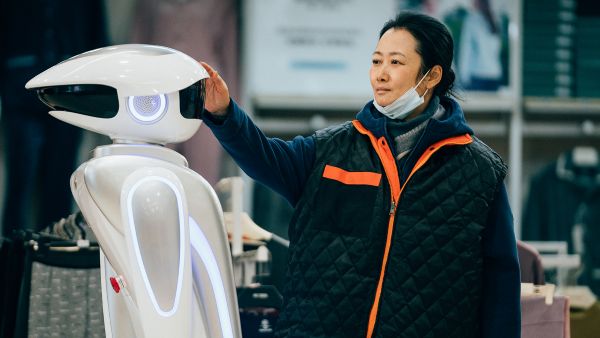
Zhao, who sings only at the film’s beginning and remains silent thereafter, is the thread binding this assemblage. Her repurposed performance is only possible because of her decades-long collaboration with Zhangke. It’s a small miracle—the emotional weight carried by these older, reframed images. They quietly build toward the final scenes, which were purposefully filmed for this project. A weary smile or a look of wonder at the sight of a robot become revelatory moments as Tao conveys entire worlds of emotion and thought. Even masked, her face speaks volumes. Her presence—her gaze—anchors the film. The long-awaited reunion of Qiaoqiao and Bin arrives without spectacle, because the passage of time is already devastatingly real.
An engrossing tale of progress and technology that captures the ever-shifting landscape of Chinese culture—from new millennium anxieties to pandemic-era confinements—Caught by the Tides is also a profound meditation on how cinema can serve as a playground for endless meaning through carefully constructed editing choices. While some directors fear the transition from celluloid to digital, Zhangke embraces the chaos and saturation of the present, TikTok references and all. Time flows with indifference. Progress marches on. Nations transform. And we yearn for a pause—a moment to dance, to sing, to be—in the knowledge that nothing ever truly stops, even as we age without mercy.

Leave A Comment