A handful of living French directors with irreverent, playful, or unpredictable reputations could pull off an homage to Godard without raising suspicions: Carax, Assayas, Bonello, Ozon, to name a few. When it comes to current American directors, the list is arguably shorter. There may be only two who, despite their Hollywood pedigree, have a body of work and a certain creative outsider spirit fit for the dubious task: Steven Soderbergh and Richard Linklater. This year, the latter has decided to put himself to the test.
Not just anyone could (or would dare to) measure up to the cinema of Jean-Luc Godard and the history of experimentation, innovation, and rebellion he represents—the tip of the iceberg being his stellar contributions to the New Wave movement—which grew more esoteric and unrepeatable with everything he did afterward. So, it’s a sign of reckless self-confidence and innocent conviction that Linklater has chosen to take on a project like Nouvelle Vague, a sort of docudrama that re-creates the shooting of Breathless. The very act of making a love letter to cinema centered on Godard’s first feature risks becoming the kind of kitschy, superficial Hollywood pastiche that the late Godard would have despised. But we are not Godard, nobody else is, so we might as well sit back and be swept away by this charming journey to the past.
With Godard at the helm, Breathless helped to promote a new kind of star beyond any actor on screen and a new source of power over producers or studios: the director as author. In fact, the critical work of the French magazine Cahiers du Cinéma paved the way for the film careers of their writers (from Truffaut to Rivette, as well as Godard) and accentuated respect for anyone who would ever step behind a camera to take control of a film from “action” to “cut.” In this way, Linklater’s contribution becomes both a statement and a representation of it. And there’s no one who better embodies the director-as-a-star symbol than the thin, elegant, arrogant, sunglasses-wearing Godard (played by a striking look-alike and voice-alike, Guillaume Marbeck), who, at 28, takes on his first movie with absolute self-assurance. Godard needed a decade of life as a critic and nearly a month of takin’-it-as-it-comes shooting to change filmmaking forever. Linklater depicts those mythic 23 days as a nonchalant act of faith and defiance, with Godard and his crew making history on the go, guided by a unique blend of intellect and instinct leading to unconventional practices: without a full script, taking rest days for inspiration, and with little concern for continuity.
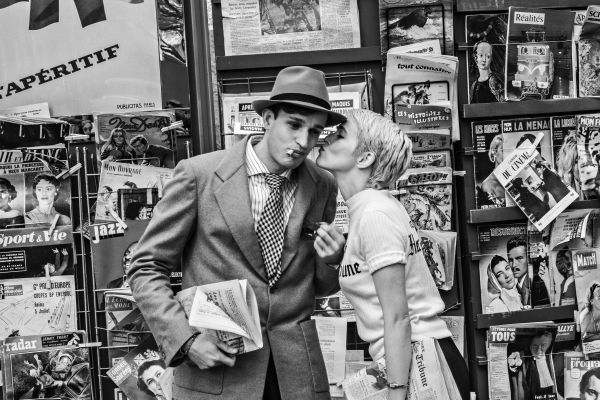
Well-known anecdotes surrounding the context and execution of Breathless are directly depicted. American actress Jean Seberg (Zoey Deutch) is persuaded by her fiancé to take part in an unconventional shoot, which she finally accepts as a way to purge her not-so-pleasant Hollywood experiences. Godard recruits Raoul Coutard (Matthieu Penchinat) as cinematographer, noting that his experience as a cameraman in the Indochina war runs counter to how fiction films are usually shot. Later, Coutard is locked inside a custom-made box to secretly film in Paris so that passersby won’t suspect they’re unpaid extras.
Meanwhile, each character is introduced with an on-screen title, allowing us to identify many of the iconic figures of the era: Truffaut, Varda, Melville, Rossellini, Bresson, among others. Every conversation comes packed with aphorisms and quotes, just in case we need reminding that we’re watching a film. With black-and-white cinematography and in French, Linklater, in part, cosplays here as an international director making a foreign film, but he also creates something joyful and spontaneous—or about what can be joyful and spontaneous in cinema when allowed.
Despite its over-stylized air of escapist entertainment, Nouvelle Vague carefully represents those involved when they aren’t sure if they have contributed to a masterpiece or a farce that would waste everyone’s time and money. Some of the best moments are between Godard and his producer, Georges de Beauregard (Bruno Dreyfürst), who lives in a constant state of alarm and irritation at the director’s eccentricities during a shoot that seems increasingly doomed to fail. Godard here is something of a prankster, perennially tormenting his collaborators while also considering them friends. Linklater doesn’t concede too much poetry to the re-creation of Breathless. Instead, you see the act of making movies as a chance to hang out with friends.
Perhaps Godard would agree, all things considered, that the result is the least questionable honor you can get from the Hollywood machine that often regurgitates and spits out the past without a trace of what was once fresh and revolutionary. Acquired by Netflix after its Cannes premiere, Linklater’s Nouvelle Vague won’t start any cinematic revolution, but it will defend the idea that making movies (and watching them) is an inspiring collective effort—one that should transcend soul-crushing concerns about profit and algorithms.


Leave A Comment