
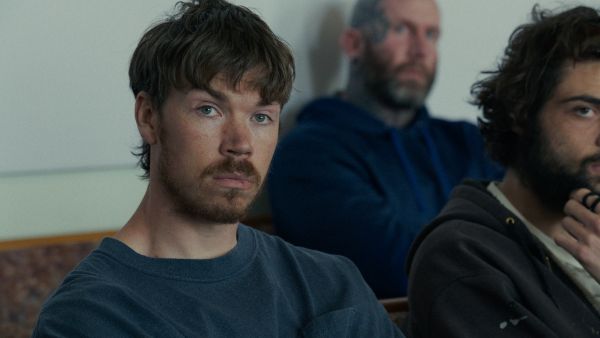
There’s a disarming quality to the opening of Adam Meeks’s debut feature. In an early courtroom scene, people struggling with addiction give a judge updates on their progress in finding housing, securing employment, and maintaining sobriety. At first, it feels almost like a documentary on the opioid crisis: There is little cinematic flourish, and the acting feels raw. Like Greg Kwedar’s Sing Sing, the film has a cast largely composed of non-professional actors—here, participants in a rural Ohio adult recovery court.
Though a familiar face, British actor Will Poulter quickly disappears into the milieu as Cody, a heroin addict in recovery. With his bangs brushed forward, a laconic Ohio drawl, a quiet temperament, and oversized clothes that look as if they were once fitted to his past build, Cody feels well-drawn and lived-in. Another familiar actor, also in his early 30s, Noah Centineo, plays Cody’s brother, Jack, who is also in recovery. More animated and talkative, with unruly dark hair, there’s an immediate contrast between the two (as characters and in acting styles—Poulter more withdrawn, Centineo fuller of fidgety, actorly tics). When Cody first sees Jack at one of the early courtroom scenes, he is visibly startled; perhaps they haven’t seen each other in months, or even years.
One of the film’s strengths is how slowly and methodically Meeks reveals aspects of Cody’s life, including when he and Jack both first became addicted and how their drug use fractured relationships with their family, including their sister, Katrina (Emily Meade). Meeks not only explores the struggles of addiction, but also how the difficult process of recovery includes trying to repair broken relationships from the past.
The many milestones of recovery are small but mighty. Cody, previously living out of his car in abandoned fields, moves into a sober house and attends ongoing recovery meetings. Isolated from others, Cody begins a friendship—perhaps a potential romantic relationship—with local Anna (Elise Kibler), though Anna, a former addict, is still working on her own path ahead, including going back to school and regaining custody of her child. For those in recovery, wins can be large, but are also small—finding a steady job, even a menial one, and getting one’s license back again. The film doesn’t sugarcoat these struggles, nor does it ever take melodramatic turns. Everything unfolds organically and feels true to the experiences being portrayed.
Meeks, who has roots in central Ohio, expands upon his 2020 short film of the same name. In both, we see laborers in a wood-cutting mill and a man living in a car in the woods. They also highlight the visual disparity between the lush green hills of their surroundings and the sterile chill of bland courtrooms. (Stefan Weinberger’s excellent, if subdued, cinematography captures these contrasts well in the two works.) A romantic relationship, the crux of the short, is held more at bay in the feature. Real-life addiction counselor Annette Deao appears in both versions as herself as well, serving as a patient, tireless force and a glimmer of hope.
In the feature-length film, one sees the growth Meeks has made as a filmmaker. His latest feels even more expansive, despite its modesty. The work by the professional cast is uniformly strong, but Poulter is quite extraordinary. Cody is internal, but Poulter conveys varying shades of emotion well. Still, the participation of the non-professional actors is vital. It never feels exploitative, and, in some ways, saves Union County from feeling too quiet and emotionally removed. Toward the end, Deao powerfully expresses the gravity of decades of her life’s work in just a single moment.




Leave A Comment