
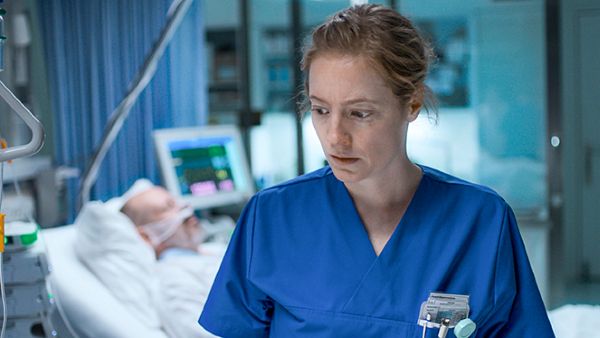
The critically acclaimed series The Pitt depicts the real-time decision-making and stress factors that medical personnel must contend with in a country where their value, worth, and respect have been diminished. The excellent new film by director Petra Volpe, Late Shift, accomplishes somewhat the same task, albeit set in a different country and less in real time, but likely more realistically.
It focuses on Floria (Leonie Benesch), a nurse whose shift in a Swiss hospital straddles the day and night hours. We know little about her except that she is a single mother and has just, after a long while, bought herself new sneakers for work. Those sneakers get a workout as the ward she is working in is understaffed even before more nurses call out sick, leaving only her and Bea (Sonja Riesen) to cover all the patients.
There is no exploration of Floria’s private life. We simply witness Floria do her job competently and professionally. There are countless shots of her walking down the hall with her cart. We watch her prepare shots at least a dozen times. Her phone constantly rings, along with the continual dings of the patients’ call buttons. After each visit with a patient, she runs through the litany of “The doctor will be here as soon as he can” or “Just press this button if you need me,” and most importantly, “Sorry, there are only two of us today.”
The patients are the usual motley ragtag of diagnoses and ailments, but how they react to Floria’s presence or patience varies greatly. The one thread that runs through all of them is uncertainty and fear. One patient has been waiting for test results for six days. Floria knows what the result is but can’t disclose it, and the doctor is too overworked to contact the man. Another has to undergo a simple gallbladder operation, but he is nauseated and worried about how it will affect his surgery. When Floria tries to give an impatient woman an IV drip, the patient yanks her arm away, stating it hurts and that no one ever gets it on the first try. Floria uses the other arm and manages to insert the IV seamlessly and painlessly; the patient is suddenly awed and relieved.
Nothing in Late Shift is heightened, like in the early films of Sean Baker and Ramin Bahrani. It simply portrays a person going through the tedium of life, but the juice of the film lies in what’s under the surface. Actually, scratch that. Adam Baiber’s score is tense and pulsating, cluing us in that we are actually watching a thriller. We know, at some moment, no matter how professional and competent Floria is, she is going to make a mistake. Each time she prepares a shot or dispenses pills, that score eerily hums in the background.
Volpe has made a deeply political and socially relevant film about the pressure on nurses and those we once called “frontline workers,” who receive praise but never get the support, emotionally and financially, they need.







Leave A Comment