
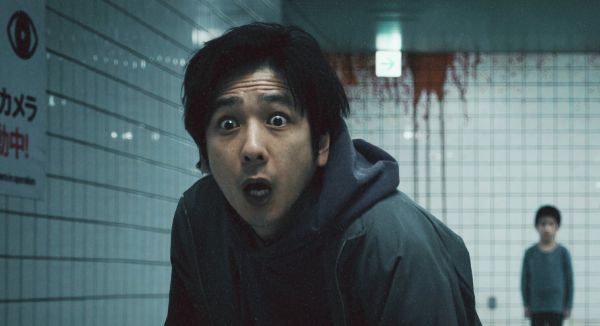
The cinema gods must feel the need to balance things out by releasing Exit 8 right after The Super Mario Bros. Movie. While the latter has raked in hundreds of millions of dollars despite a so-so plot, it’s unclear whether the former—another video game adaptation—will do quite as well financially despite telling a compelling psychological horror story that doesn’t require preexisting gaming knowledge. But it really, really should.
Based on the 2023 indie game, Exit 8 feels like an embodiment of the belief that limitations breed imagination. Its gimmick revolves around a time loop of sorts where the protagonist must navigate an endless series of subway corridors while keeping an eye out for anomalies in each location that feel out of place. The movie even opens with a first-person perspective in the style of the game, following a nameless individual (Kazunari Ninomiya) whose journey leaving a Tokyo subway train is itself a marathon. Lost in his headphones while heading to work, our protagonist (dubbed the Lost Man) fails to stand up for a mother when another passenger berates her baby’s crying, then learns from his ex-girlfriend over the phone that she’s pregnant. This news causes the Lost Man to have an asthma attack and, upon trying to continue his journey, he discovers that something is off: He literally cannot escape the subway station.
Attempts to find a way out of the underground tunnel go absolutely nowhere, instead he passes through the same four corridors and turns without end. One corridor is frequented by an older man (Yamato Kochi) carrying a briefcase, forever walking past him like an animatronic before appearing in a “powered down” position a few corridors later. However, a sign on the wall provides clear rules for how to get out. On each loop, the Lost Man must observe his surroundings for anomalies, be it posters on the wall changing their appearance or the old man sporting a creepy serial-killer grin. If he sees one, he must turn around; if it all looks good, he must keep going in the direction of Exit 8. But make one slip-up, and the loop resets itself all over again.
The strength of Exit 8 lies in its simplicity, establishing a twisted sense of logic to the environmental puzzles. Memorization is key to survival, with the Lost Man counting off the various icons per hall to ensure he keeps track of anything suspicious. But the further he gets, the more cerebral these tricks become, presenting anomalies as real-world encounters or even freakish J-horror imagery. Cinematographer Keisuke Imamura follows the man via extended single takes that withhold changes to the route from the man’s and the viewer’s field of vision. Because he can’t see them, neither do we, producing an experience that feels as much like playing a game as being exposed to arduous mind games.
Exit 8 gradually expands upon its loop’s complexity by introducing new perspectives, including a young boy (Naru Asanuma) with a keen sense of observation. The nature of the various tests is up to interpretation, but fatherhood is clearly a key theme. Realizing he might become a father kicks off the young man’s internal and external dread, while gradually coming to accept such responsibilities mirrors his interactions within this maze. The other encounters aren’t quite as fleshed out, but director Genki Kawamura successfully weaves their storylines into the protagonist’s dilemma to see whether he’ll learn something from them. For better or worse, this growth also mirrors Exit 8’s visual transition, beginning with extended game-like long takes before adding more cuts between scenes as it nears the third act—the final sequence leaves plenty to interpretation.
When translated from game pixels to live-action, Exit 8 remains astonishingly haunting and immersive as a concept, even if its story never grows quite as deep as its in-universe mechanics. That Exit 8 can hook people without them being aware of its source material is impressive enough. Compared to the recent Mario adventure, it at least knows how to tell a complete story.










Leave A Comment