
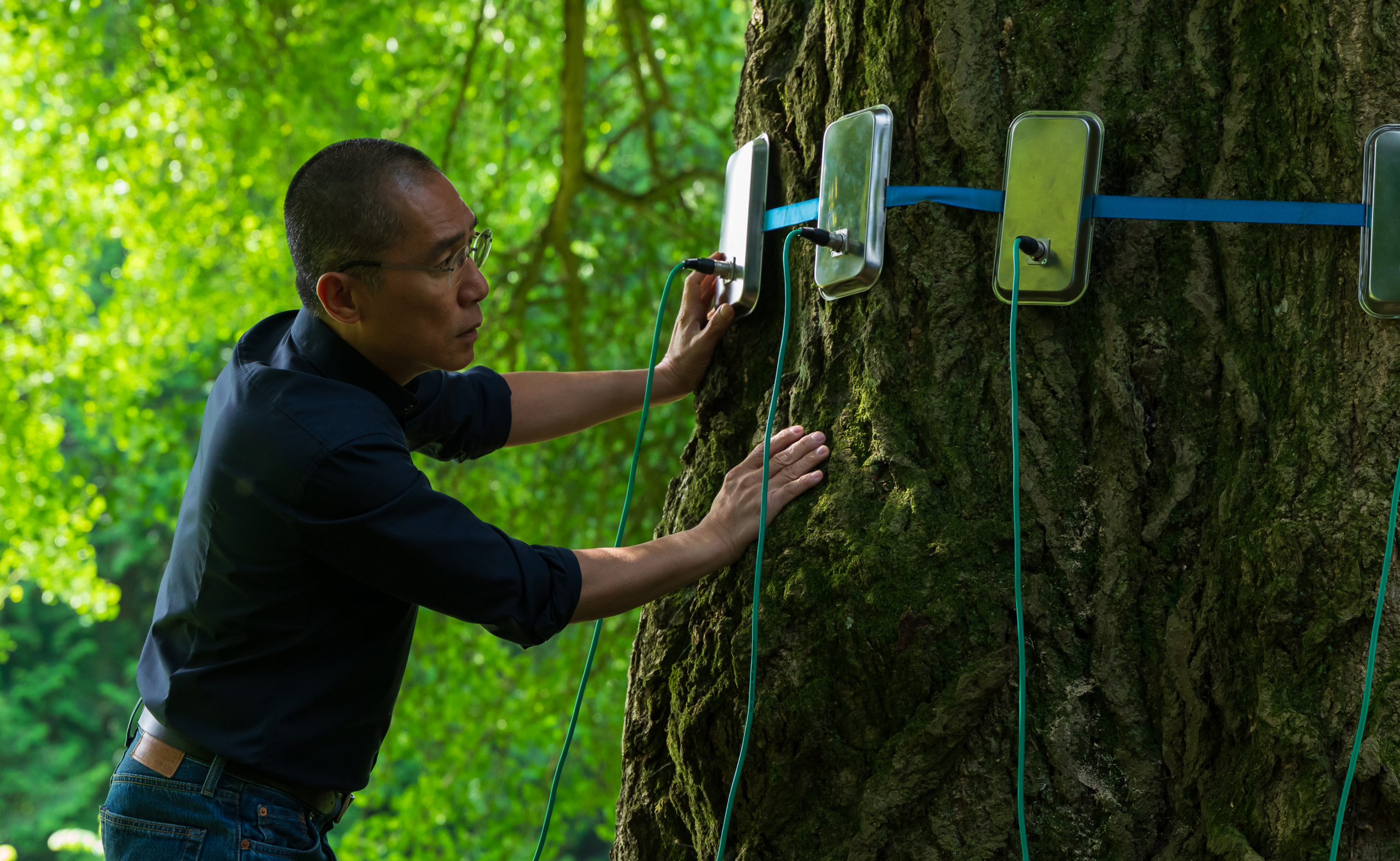
Is solitude only experienced by humans? Ildikó Enyedi’s latest film, Silent Friend, asks this question by placing a ginkgo tree on the grounds of Germany’s Marburg University at its center—a silent witness to the passing of time. A gymnosperm (or seed-producing tree) native to East Asia, the ginkgo has often been called a “fossil tree” because it has changed little biologically since the early Permian period over 200 million years ago.
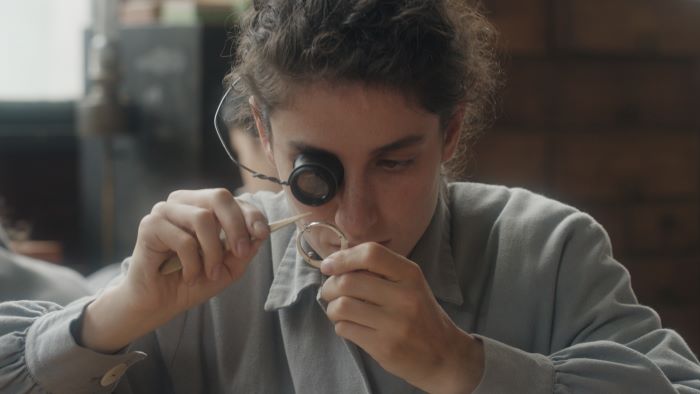
The film focuses on characters from three different time periods who are drawn to the tree as a result of their solitude. In the most recent storyline, neuroscientist Dr. Tony Wong (Tony Leung Chiu-wai) stumbles upon a ginkgo that dates back to 1832. He is in Marburg to give lectures on his research into the brain activity of newborn babies (which he says resembles an adult’s brain on psilocybin), yet his studies have been cut short because of the Covid-19 lockdown. In 1908, and in the most dramatic section, young feminist Grete (Luna Wedler) applies to Marburg’s botanical department. Subjected to a sexist interview process, she becomes overwhelmed and finds her escape in the botanical garden and the ginkgo tree. Later, isolated student Hannes (Enzo Brumm) spends his days reading under the same tree in 1972 when he meets the free-spirited Gundula (Marlene Burow), who conducts research on the unlikely companionship between plants and humans.
Enyedi uses nature in a way that has an element of magical realism, a style also seen in her previous film On Body and Soul, which deals with the overlapping, nature-centric dreams of two abattoir workers. Despite appearing naive and lost at first, Enyedi’s characters hold so much curiosity about their inner worlds that they become fully merged with nature in a way that serves as a mirror to this interior. The film also questions the very nature of insularity by giving life to a seemingly non-reactive and non-human being.
Enyedi subtly and soulfully presents the ginkgo as a source of enlightenment that indirectly inspires Grete to explore photography, Hannes to spend his time tending to a purple geranium, and Dr. Wong to help fertilize the ginkgo with the aid of his colleague, botanist Dr. Alice Sauvage (Léa Seydoux, who manages to build a strong chemistry with Leung Chiu-wai despite being seen only through video calls). While it is without a doubt that Leung Chiu-wai is a perfect fit for a solemn and serene character like Dr. Wong, the other lead actors, Luna Wedler and Enzo Brumm, portray their respective characters with great complexity. It is remarkable that the script connects the three intertwined and loosely linked storylines through a never-ending search for meaning and purpose rather than concrete, parallel events.
The poetical visual language evokes a meditative and transformative journey. Gergely Pálos’s cinematography is a respectful salutation to the grandiose ginkgo itself, with the tree centered as a mighty yet friendly presence. Each section also has a texture and color reflective of its time, such as the use of black and white for the early 20th century or the grainy, 1970s film stock used for Hannes’s time period.
Silent Friend powerfully communicates a message of companionship between humans and nature. It is a poignant and sprawling film that uses the solitude of its characters to reveal their vulnerability.






Leave A Comment