

When we talk about ghost stories, we may immediately think of darkness and fog, gothic romances, or spectral figures haunting the living. These tropes are so recognizable that we take them for granted. Yet stripped of all those embellishments, a ghost story fundamentally depends on a lingering presence no longer counted among the living and a pulsing sense of longing. Forastera needs only those elements to tell its own peculiar and unclassifiable ghost story, delightfully subversive in the way it unfolds under bright summer sunlight, in wide-open and illuminated spaces.
The directorial debut of Lucía Aleñar Iglesias expands upon a concept previously explored in one of her short films, blending coming-of-age adolescent drama with ghost story conventions, though without relying on overt tricks or scares. One could say the film constructs an uncanny mood rather than a haunting atmosphere, and it takes its time unraveling it. Meanwhile, the Mallorcan setting allows the Spanish director to seduce the audience with pristine beaches and skies while telling the story of teenage girl Cata (Zoe Stein) and her family over the course of a crucial summer.
Two teenagers sunbathe on the beach, fully immersed in the joys of the summer they will spend at their grandparents’ house: Cata and her younger sister Eva (Martina García), the latter dismissing what is probably Cata’s invented anecdote about a dolphin. One girl clearly possesses an overactive imagination, while the younger one is more skeptical. Cata shares her name with her grandmother Catalina (Marta Angelat), who always seems busy cooking or tending to household chores. Meanwhile, grandfather Tomeu (Lluís Homar) lounges around more leisurely, playing poker with friends on the patio and constantly postponing fixing the flickering kitchen light—its defect is blamed on a supposed ghost haunting the house. (It’s a shared little joke.) The absent figure here is Pepa (Núria Prims), who speaks with her daughters over the phone from Madrid yet seems reluctant to join them for the summer.
Aleñar Iglesias provides enough visual cues and fragments of dialogue for us to understand these characters as though we had known them our entire lives. The naturalistic characterizations create an immersive and palpable experience of this small, mundane family universe, as if we were peeking into real lives we can easily recognize and identify with.
The family dynamics, in what initially appears to be just another ordinary summer, are suddenly shattered when Cata discovers her grandmother dead on the outdoor stairs leading into the house, seemingly the victim of a fatal fall. Inevitably, Pepa returns to her parents’ house to oversee the funeral while each family member navigates grief in their own way. Yet the director focuses specifically on the experiences of Cata and Tomeu, who are affected differently but ultimately grow closer because of the loss. This is where the film gradually begins embracing the idea of a ghost story, as Cata appears increasingly compelled to fill the void left by her grandmother’s absence.
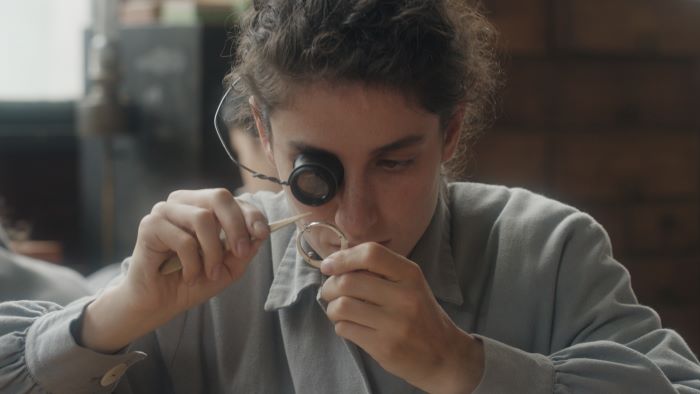
Cata starts wearing some of the dresses her grandmother had saved from her youth, and small gestures can perhaps be interpreted either as troubling signs or coping strategies from someone who has not even taken the time to mourn properly. Her grandfather indulges these mind games to such an extent that we begin wondering whether the film might veer into more dangerous, taboo territory. But any such suspicion quickly dissipates. However, at a certain point, the intrigue expires and boredom becomes the dominant feeling.
International audiences will likely recognize Homar, a veteran of Spanish cinema and theater, from some of Pedro Almodóvar’s films (Bad Education, Broken Embraces), and his presence undeniably elevates a movie that places most of its dramatic and symbolic weight on the shoulders of its young protagonist. Stein, meanwhile, is hardly a newcomer, having already appeared in previous series and films. She returns here to reprise and expand the role she first played in the director’s 2020 short film, creating what feels like a full-circle moment for both actress and director.
Still, Stein’s performance, as inscrutable as it is cryptic, eventually weighs down the hour-and-a-half runtime, and the contrast becomes noticeable whenever an actor like Homar steps in to fill dramatic voids we wish had been more fully developed—and emotionally felt. Likewise, the underwritten nature of Pepa and Eva ultimately reinforces the impression that this remains the same short film stretched beyond exhaustion, rather than a meaningful opportunity to deepen the family portrait.
Perhaps some stories are meant to remain confined to their original brevity, but it is easy to understand why certain artists need more than one opportunity to exorcise the stories that haunt them like the ghosts that they do not know how to say goodbye to.






Leave A Comment