
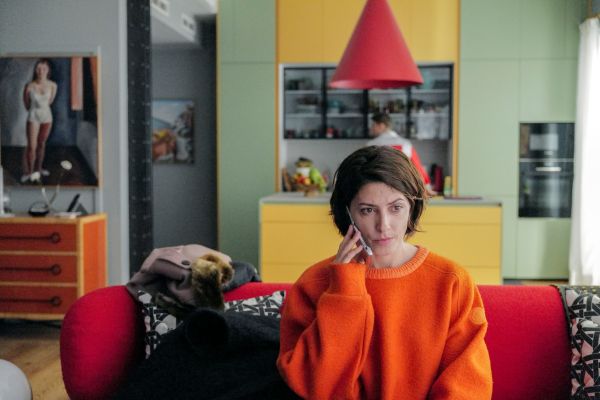
Pedro Almodóvar may be the only director who can color-coordinate so effectively that even the interior of an ambulance or a hospital looks aesthetically pleasing. Yet beneath his stylish, eye-catching surfaces, darkness, ambiguity, and a wandering sadness lurk. Following 2024’s The Room Next Door, a relatively straightforward, linear drama punctuated by a scattering of flashbacks and narrative surprises, Almodóvar returns with a far more layered and twisty meditation on loss, relationships, and the art of writing.
The story begins in December 2004, focusing upon a seemingly happy couple: Elsa (Bárbara Lennie), a chic advertising filmmaker in Prada shades whose previous foray into fictional filmmaking resulted in two disappointments, and her boyfriend, Bonifacio (Patrick Criado), a firefighter who also moonlights as a stripper at bachelorette parties. (Almodóvar takes gratuitous pleasure in showcasing him.) Elsa, who lost her mother a year earlier, has recently begun suffering from migraines and panic attacks. Desperate for relief, she reaches out to one of her friends, Gabriela (Rossy de Palma, one of Almodóvar’s key muses, in a brief but impactful turn), a prominent patron of the arts scene who throws splashy parties.
The party offers a glimpse of the hip milieu Elsa inhabits, as well as her emotional and physical fragility. She hides from the other guests on a bed covered in their coats, waiting for Gabriela to bring her tranquilizers. At one point, she tears up while watching an impromptu performance of “Las simples cosas,” a song famously performed by Chavela Vargas and covered here with delicacy and sweetness by one of the partygoers, musician Amaia Romero.
In Almodóvar’s use of repetition and doubling, Chavela Vargas’s music figures later between Elsa and her good friend Patricia (Victoria Luengo), whose husband is constantly leaving her and their child behind. The film’s title refers to the song “Amarga Navidad,” which the two women listen to at Patricia’s home, moved to tears by the music under the glint of Christmas lights. Vargas’s vocal is guttural and emotionally wrenching as Patricia despairs at the thought of her husband spending the holidays in Paris with another woman.
Elsa has another friend suffering from loss as well, Natalia (Milena Smit), a young model whose son has died in what is presumed to have been an accident. The child is conveyed indirectly through details, a photograph for example, and, in Almodóvar fashion, through the appearance of another, similar-looking child whom Natalia sees.
Meanwhile, early on, the film establishes that Elsa’s entire storyline is being written in 2026 by Raúl (Leonardo Sbaraglia), a prolific screenwriter and filmmaker who serves as an obvious stand-in for Almodóvar. In some respects, he recalls Antonio Banderas’s storyteller in Almodóvar’s Pain and Glory. Raúl lives with his dashing boyfriend, Santi (Quim Gutiérrez), in an elegant dwelling with a pool. He is resigned to the idea that the piece he is writing will be a minor film, but he is also experiencing a creative breakthrough after feeling stagnant in his writing for quite some time.
Is Raúl Elsa? Is Santi Bonifacio? Is Raúl’s friend and longtime assistant, Mónica (Aitana Sánchez-Gijón), an amalgam of Elsa’s friends Natalia and Patricia? Here Almodóvar playfully explores some of the ethical quandaries of autofiction. In fact, it could make an interesting pairing with Nathan Fielder and Lance Oppenheim’s You Can See Everything, which similarly invites the viewer to consider the ethical dilemmas of filmmaking, in this case a documentary. Possibly intentional on Almodóvar’s part, the scenes involving the blandly sketched Raúl ultimately prove less involving than the more intimate story Raúl is creating.
Overall, the dramatic elements sometimes feel somewhat distant, perhaps because of the story within a story conceit and the film’s crafts, which are gorgeous, but maybe too distractingly so. I noticed how the red K on a box of Special K in a kitchen cabinet seemed like a painstakingly chosen brushstroke in another one of Almodóvar’s stunning interiors. Cinematographer Pau Esteve Birba’s camerawork, which lingers over the alluring cast and locations, is sumptuous. Longtime collaborator Alberto Iglesias delivers yet another propulsive and ravishing score, its prickly strings ginning up excitement as Raúl types away at his screenplay. However, the film’s major dramas largely occur offscreen, referenced only indirectly and kept purposefully blurred. At one point, a photograph of Patricia’s husband with another woman appears pixelated on a cellphone. (Whenever Motorola flip phones appear onscreen, some viewers may feel a pang of nostalgia for their technological simplicity.)
Throughout, there is a knowing interplay between what the artist creates and the lives of the people who inspire that creation, alongside a self-conscious commentary on filmmaking itself. Raúl refers to his screenplay as a minor film, a description I would apply to Almodóvar’s latest too, as the filmmaker seems to be admitting in this film as well. Even so, like most of his work, it remains dishy, rich in detail, and endlessly fascinating.










Leave A Comment