
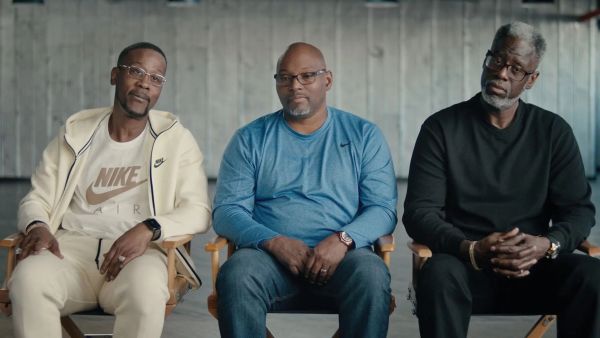
What would you do if someone knowingly lied about you, and their lie put you in prison for nearly 40 years? Would you forgive them? Would you even want to hear what they had to say?
Dawn Porter’s extraordinary new documentary, When a Witness Recants, confronts these unsettling questions through the story of three men, Alfred Chestnut, Andrew Stewart, and Ransom Watkins, who spent 36 years in prison for a murder they didn’t commit. The film is about many things: inner-city violence, institutional racism, police misconduct, and the catastrophic failures of the American justice system. These are familiar subjects, explored in countless documentaries. However, the film’s title points toward something more intimate and morally complicated: the encounter between those who lost their freedom and the man whose testimony took it away.
Writer Ta-Nehisi Coates remembers Baltimore in 1983 as a place of both innocence and violence. Coates grew up there around the time of the events depicted here, and his recollections establish a peculiar tension between the two. Violence was around, but it had not yet fully disrupted the somewhat idyllic existence of Baltimoreans back then. That changed on November 18, when 14-year-old DeWitt Duckett, a well-liked student, was shot and killed in a hallway at Harlem Park Junior High School, apparently for his fashionable Georgetown University jacket. Coates describes the shooting as a rupture in his understanding of the city, a moment when childhood itself seemed to change. (Coates is among the documentary’s executive producers.)
Porter reconstructs the atmosphere of the time through an extensive collection of archival news footage, neighborhood interviews, and contemporary recollections. The killing became a media sensation, inspiring public fear, which grew into outrage and demands for greater school security. There is a palpable urgency to find the murderer, an urgency that gradually reveals itself to be part of the problem.
Chestnut, Stewart, and Watkins were pulled from their homes on Thanksgiving, arrested, and charged with Duckett’s murder. All three were friends with the victim and maintained their innocence. The prosecution’s case rested largely on the testimony of four teenage witnesses, most notably Ron Bishop and Edward Capers, who claimed to have seen the three boys commit the crime. Yet their testimony was riddled with inconsistencies, vague recollections, and contradictory statements. Under ordinary scrutiny, the case should have collapsed.
The reconstruction of the investigation, aided by graphic-novel-style animation and extraordinary footage from depositions taken decades later, reveals an almost unbelievable succession of abuses. Lead detective Donald Kincaid allegedly threatened Bishop, then only 14 years old, with prosecution as an accessory to murder unless he cooperated. Prosecutor Jonathan Shoup helped perpetuate the questionable narrative, while crucial police reports and evidence pointing toward another suspect were withheld from the defense. The boys were convicted and all sentenced to life in prison.
To make an appeal, the three men set to work studying their case. Yet it takes Chestnut seven years to obtain a transcript of their trial, and an unbelievable 36 years to secure the police report that should have been available to the defense during the trial. The state sets up an unreasonable number of bureaucratic rules and hurdles in order to get these documents, and also charges for them, which the convicts lack the means to pay.
In 2019, Chestnut finally receives the police report and quickly realizes that it all but proves their innocence. He contacts Baltimore’s newly formed Conviction Integrity Unit, which begins reexamining the case, and things move quickly. The men are released in expedited fashion on the Monday of Thanksgiving week, so that they can spend the holiday with their families, a full-circle moment.
The climax is a meeting between the three men and the witness who put them in prison, Ron Bishop. Interviewed throughout, Bishop says he has struggled with guilt his whole life, and now is given a chance to face the men whose lives he destroyed. The three are ready to hear him out and potentially forgive him. The exchange has a kind of unhinged energy, a sense that anything might happen, that the participants themselves have no idea where the conversation is going. It is one of those rare documentary moments in which reality becomes more unpredictable, more uncomfortable, and more dramatically compelling than anything a screenwriter could construct. The painstakingly built-up awkwardness suddenly unspools in front of you, and you can’t believe it’s real, but it is.
A tragic, unforgettable story, When a Witness Recants depicts the complexities of forgiveness in as vivid a fashion as you’re likely ever to see.



Leave A Comment