
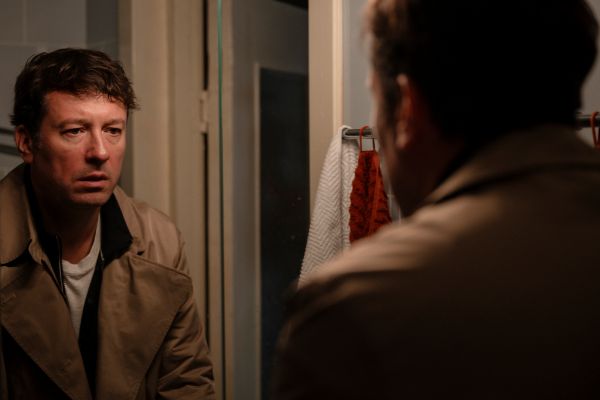
Evil escalates under an impassive gray surface in Andrey Zvyagintsev’s Minotaur, as lies bloom into betrayals and betrayals lead to deals with the devil. Based lightly on Adrian Lyne’s 2002 domestic melodrama Unfaithful, itself a remake of Claude Chabrol’s The Unfaithful Wife, this absorbing, tightly controlled tale starts by unearthing family discord, then widens out to reveal the corruption and cruelty feeding Russia’s invasion of Ukraine. The film won Zvyagintsev the 2026 Cannes Grand Prix and represents a strong continuation of the moral conflicts he explored in Leviathan and Loveless. (Now based in France, Zvyagintsev made this in Latvia.)
Gleb Morozov (Dmitriy Mazurov) is a man of serious assets: a huge and tastefully appointed modernist house, an expensive car, and a beautiful, willowy wife (Iris Lebedeva). Handsome cinematography showcases these possessions—Galina, the wife, is surely one—with a stylish sheen and establishes Gleb as monarch of the realm. But Galina shrinks from Gleb’s touch. Malaise has set into the marriage, and Gleb suspects Galina is hiding something. He hires a detective who confirms Galina’s affair with a bohemian young photographer, then begins trailing her and her lover. His stalking sets the film’s preoccupations: secrecy, pursuit, and the elimination of any threat to the status quo.
Plots are stirring at Gleb’s office, as sleek and dark as his home. The war outside is starting to intrude on his shipping and logistics business. Under duress from a crooked mayor, Gleb is forced to provide a quota of men from his company to sustain Russia’s war effort. He uses a ruse to entrap and press-gang a group of poor souls for delivery to almost certain death; when he meets and slickly lies to them, their proletarian air and worn clothes offset his own privilege.
The executive knows how to make people disappear. The director’s style reinforces this authority and sense of predetermination. Tanks roll to the front by train, draftees line up for processing, and Gleb arranges the liquidation of another inconvenient man in his life, all as though fulfilling destiny. Zvyagintsev cleverly varies the rhythm with scenes of vulnerability in almost real time. One instance is a sexy, spontaneous romp with Galina and her younger lover, the camera lingering voyeuristically as the photographer snaps incriminating images. Another plays out when the always-composed Gleb loses his cool trying to dispose of an almost-dead body. He kneels like a washerwoman frantically cleaning a bloodstained floor, then takes a wild (and bleakly funny) risk to finish off his quarry and lower the corpse downstairs fast.
Performances are key in a film this calibrated, and Mazurov and Lebedeva play off each other resourcefully. Mazurov’s deadpan face and bull-like body convey his drive to master events. In a showier role, Lebedeva moves from indolence to passion, then through a struggle to contain terrible suspicions. The couple barely speaks, yet each gives away more than they realize.
It takes a lot of inner desperation to maintain a facade of command, and a lot of complicity to facilitate and cover up dirty deeds. In Minotaur, we witness both at work. Zvyagintsev briefly leaves Gleb and his family to focus on exhausted-looking conscripts being pumped up by nationalistic officers and priests. As a bus bears the men away, a woman breaks down in uncontrollable weeping. These disquieting scenes mount an overt critique of Russia’s war machine and underscore the point that the foul maneuvers of the Russian state mirror the mortal sins below Gleb’s appearance of success. The allegory isn’t subtle, but it holds a cold judgment in this knowing, powerful film.







Leave A Comment