
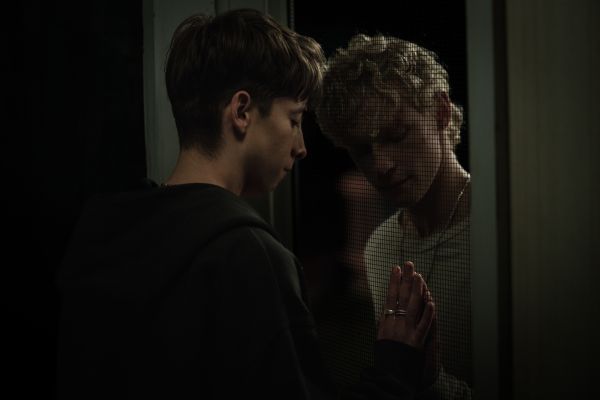
The opening of Leviticus feels like business as usual for a typical slasher movie, as a teenage girl goes down on an unseen partner while the voyeuristic camera lurks from a distance before the tragedy about to unfold. The scene takes place in a high school swimming pool in the middle of the night. Moments later, passionate fumbling gives way to screams of pain, and the girl, covered in blood, tries unsuccessfully to escape something—or someone.
Conceptually, however, Leviticus is not exactly a slasher. The difference is that the monster here is not a masked figure but an invisible demonic (or perhaps celestial?) force that appears to its victims in the form of the person they most desire. Nor does it manifest itself to just any horny teenager; it is a supernatural entity specifically invoked to target queer people. This is where the Australian horror film immediately distinguishes itself while creating an intelligent allegory against bigotry and hate crimes.
Director Adrian Chiarella’s feature debut stands out for the way it translates its ideas both visually and narratively, further confirming 2026 as an exceptional year for new voices in horror (alongside Backrooms, undertone, and Obsession). Horror is only one of the many layers at work. Simultaneously a coming-of-age queer identity journey and a gay love story, the trials and tribulations of the two teenagers feel like a cry against intolerance in an era when homophobia continues to damage lives.
Set in rural Australia, on the outskirts of Melbourne, Leviticus keeps its focus on a small group of characters and a town under the dominant influence of its fundamentalist church. There live Naim (Joe Bird) and Ryan (Stacy Clausen), the potential “final boys” of this story—or perhaps they will inaugurate the trope of the “final gay couple” as a response to the “bury your gays” convention, in which gay-coded characters are either victims who do not survive or, alternatively, the aggressors.
At first, neither boy fully recognizes himself as gay, much less understands the possibility of mutual attraction. During a walk through the isolated countryside, punctuated by pranks, increasing teasing, and harmless insults, they end up on top of each other doing something more than roughhousing. It is the first time—at least for Naim—that something like this has happened with another boy. They kiss, and they are not afraid until they fear someone might see them. They may not yet fully understand what being gay means, but they clearly recognize that homophobia exists. That is the difference between gay and straight desire at a young age: It cannot simply be carried along by the joy and grace of discovering new feelings and sensations. It necessarily comes with awareness and caution as a survival mechanism.
Naim lives with his strict mother, Arlene (Mia Wasikowska), having recently moved to the town after his father’s death from illness. Sunday services are mandatory, and for the devout widow, they are the best way to integrate into this new community. Meanwhile, Naim clearly wants to explore things further with Ryan after they have taken that first step together. His hopes are crushed, however, when he catches Ryan secretly smooching with another boy, Hunter (Jeremy Blewitt), the pastor’s son. Consumed by jealousy, he makes a fatal mistake that brings misfortune upon all three teens.
Enduring a plight no one else can see or understand, the victims here encounter a familiar face and body, speaking to them and seducing them, until it suddenly begins attacking them with brutal and merciless violence. Escaping an attack is not impossible, but the monster always returns, so that you can never trust that the person you love the most will not become your downfall. In a way, the premise serves as a perfect metaphor for life in the closet, which is precisely what this entity seeks to impose upon a rural community’s black sheep: that they remain in constant fear, repressing their feelings if they want to survive.
For its part, the way the entity’s attacks unfold and the relentless pursuit it subjects its victims to owes a considerable debt to the relentless chases and bursting violence of It Follows. Certainly, being compared to David Robert Mitchell’s film—one of the defining horror movies of late—could be a disservice to minor imitators, but Chiarella’s work maintains enough identity and authenticity to exist as more than merely the queer version of that modern classic.
Its most terrifying moments are not the compelling sequences of supernatural violence and pursuit, but rather the instances in which ordinary people calmly and coldly decide that compassion has limits because preserving the rigid foundations of a faith matters more. Conversely, the fight portrayed here—which feels more significant than in many other horror films—is not merely about survival, but about defending the life you want to live according to who you are and whom you love, without shame or regret.




Leave A Comment