
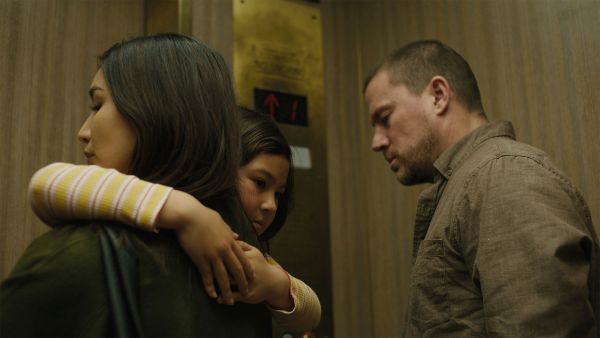
After reading the premise of the engrossing and discomforting Josephine, rest assured that the remarkable juvenile actor in the title role, Mason Reeves, was protected during production.
The eight-year-old and her jock dad and erstwhile coach (Channing Tatum) head to San Francisco’s Golden Gate Park early on a Sunday morning to practice soccer. Horsing around, they play hide-and-seek, and Josephine runs off into the dense foliage to hide. Alone and away from her dad, she stumbles upon a crime: the brutal rape of a female jogger.
The sexual assault is filmed from the girl’s point of view, crouched about 50 feet away and hidden by greenery. Still, viewers might be pulled out of the film wondering how this sequence was shot. I assumed the young actor wasn’t on set at all, and according to the press notes and publicist, I was right: Reeves was directed on how to react to different scenarios without knowing what was actually taking place in the storyline. Filmed in a wide shot, the rape is depicted more graphically than is standard in U.S. indies, leaving the drama feeling unencumbered as it tackles a delicate story. The film sprang from director Beth de Araújo’s own experience: When she was eight years old, she and her father interrupted a rape in the same park, and, much like in Josephine, her dad ran after the assailant.
The weight of the entire enterprise rests on the young actor’s shoulders—a heavy responsibility for any performer, let alone one in elementary school, given the subject matter. Reeves is in virtually every scene, as the drama centers on Josephine and her reactions. They run the gamut from perplexity and frustration over not getting straight answers from her parents to anger and, in many instances, violence, all convincingly portrayed. Araújo’s screenplay doesn’t pull any punches, boldly and sensitively examining the reverberations of Josephine witnessing the crime.
Left largely on her own to make sense of what happened, Josephine tries to find answers to questions she can’t quite verbalize. Damien (Tatum) ignores her inquiry into what the assailant was doing, and in the back seat of the family car, Josephine looks up the word “rape,” misspelling it “raiped.” Perhaps intuitively, she backs away from an older man staring at her in another aisle at a big-box store. Araújo also weaves in an effective, eerie, and surreal touch: Josephine sees the rapist (Philip Ettinger) in her room, lingering as if stepping out from the back of her mind.
Her well-to-do parents don’t know how to handle her questions or her episodes of acting out, one of which is left perplexingly unexplored. Claire (Gemma Chan) feels her daughter should see a therapist—a sentiment much of the audience will share. On the drive to the appointment, Josephine dashes out of the car, endangering herself. Wanting self-defense classes instead, she strikes a bargain with her dad: no running away in exchange for skipping therapy and learning jujitsu. Damien dominates the conversation, or arguments, with his wife, steering their decisions. Claire acquiesces without much of a fight, even though Josephine acts out in ways that hurt others. (Viewers, buckle your seat belts.)
Even amid the intense performances, practical questions can distract from the movie, most notably how the parents afford living in pricey San Francisco, let alone move to a new home in the city. They relocate out of fear that the accused rapist is stalking Josephine and leaving threats ahead of a trial where she may testify. After all, Claire is a member of a modern dance company, and Damien’s occupation goes unstated, leaving their financial comfort a mystery.
The script also packs in one too many episodes of Josephine’s alarming behavior, including a rushed subplot involving her mother’s health that leans more toward shock value in contrast to the film’s otherwise subtle, convincing tone. Still, the screenplay captures an eight-year-old’s behavior well during her interview with a police detective: Describing what she saw, she breaks into quiet giggles over the man’s “ding-a-ling.” Once she finds out that there are others watching the interview from behind a pane of glass, she approaches it and jumps up, making funny faces.
Because of how the filmmaker handles the fraught and dark subject matter, Josephine ranks as one of the most impressive U.S. films this year.


Leave A Comment