
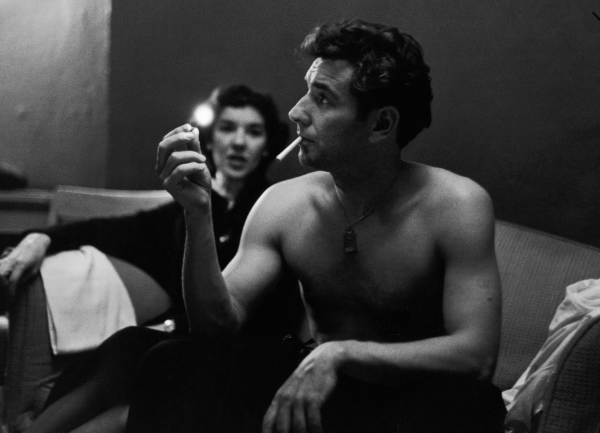
If there was ever a rock star in classical music, it was Leonard Bernstein. The multihyphenate artist (conductor, composer, pianist, and music educator) became famous in 1943 when, as an unknown assistant conductor, he replaced an ailing Bruno Walter to lead the New York Philharmonic at the last minute. Without a rehearsal, he conducted a concert that became legendary, keeping him at the forefront of the music world for almost five decades.
In Douglas Tirola’s perceptive, if at times diffuse, documentary, Bernstein narrates his own story through a series of insightful video and audio clips. Tirola had an embarrassment of riches to choose from; not only was Bernstein always happy to talk in front of a camera or a microphone, but he was also articulate and eloquent on subjects ranging from music and politics to social issues and his private life. Even difficult-sounding modern classical music became accessible, even enjoyable, through Bernstein’s tireless advocacy.
That advocacy—for music as well as social justice and politics—is the center of Bernstein’s Wall. Although Tirola nods to a standard biographical portrait by providing a brief account of Bernstein’s childhood under a domineering Jewish father who emigrated from Russia and initially opposed his son becoming a musician, the film soon moves in other directions.
Bernstein’s celebrity bully pulpit allowed him to passionately advocate for what was close to his heart. The Cold War was the ominous backdrop when Bernstein visited West Berlin in 1961 to conduct in a city divided by a wall constructed by the Soviets. He speaks of this as an important cultural exchange between the West and the East and mentions that the orchestral performance occurred on Rosh Hashanah, the Jewish New Year—another way to bring diverse people together.
With so much archival footage at his disposal, Tirola constructs a breezy portrait of an artist at ease with his artistry and celebrity, using both to publicize the issues he cared about most. There is a clip of Louis Armstrong and Bernstein performing together, and in another concert, piano soloist André Watts, whose father was African American and mother was Hungarian. An unapologetic liberal, Bernstein admitted that his request for a passport was denied because of his political affiliations during the height of McCarthyism in the 1950s.
If there is a fault with Bernstein’s Wall, it is that it tries to cover too much, often tantalizingly mentioning a topic before moving on. Getting short shrift is Bernstein’s composing career; there are brief segments about West Side Story and On the Town, but nothing at all about Candide or Wonderful Town. We hear snippets of his grave-sounding symphony subtitled The Age of Anxiety, but there is no mention of his later, even more personal work, Symphony No. 3: Kaddish.
Bernstein’s sexuality is not ignored, but it is such a rich subject that it deserves more screen time. (Tirola could have easily made a multi-part series instead.) Though he had many sexual relationships with men, Bernstein married Costa Rican–born Felicia Montealegre, with whom he had three children. She knew about his sexual orientation and made peace with it, writing to her husband, “You are a homosexual and may never change,” in one of several sequences where Tirola uses elegant onscreen script to visualize Bernstein’s most intimate correspondence. This includes allusions to what was likely a sexual relationship with one of his mentors, composer Aaron Copland.
Despite what some might consider “bleeding heart” liberal politics, Bernstein was a musician first, and his ability to convey the depth of composers like Beethoven and Mahler was unmatched. When conducting their work, Bernstein was emotionally engaged and always persuasive. He leads a performance of Beethoven’s Ninth Symphony—with its glorious “Ode to Joy” finale—in Berlin after the fall of the Berlin Wall, signaling the end of the Cold War. There is a sea change in his demeanor on the podium. Normally so ebullient with his gestures, he ends the performance entirely still, as if the extraordinary music he has just conducted has made any further movement unnecessary. He looks completely exhausted, yet completely satisfied.



Leave A Comment