
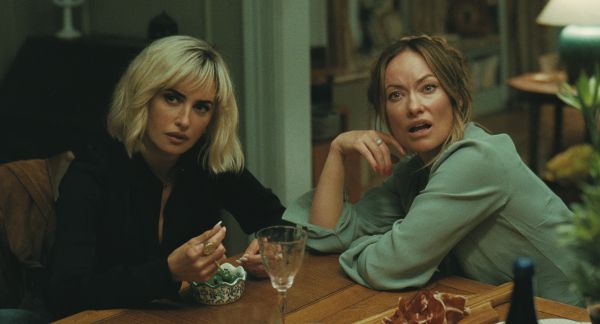
There is some truth in exaggeration; it reveals the things we do not entirely want to admit to in a ridiculous way that can be dismissed as a joke. So, if we say that hell is other people, we can laugh at our self-confessed misanthropy. And if, instead, we say that the real hell is marriage—a thing many married couples would admit half-seriously and half-jokingly after a few drinks too many—then those involved do not feel as though they are confessing to a lifelong mistake, but rather sharing a complicit secret to liven up the evening. Broadly speaking, this mood defines The Invite, a hysterical tragicomedy that happily embraces hyperbole.
If Booksmart was an electrifying and promising debut perfectly in tune with the zeitgeist, the response to the sci-fi dystopia Don’t Worry Darling was inversely proportional. It became the kind of failure and cautionary tale in the annals of Hollywood more because of the behind-the-scenes gossip than the actual result itself. (That movie is not even that terrible, but it probably won’t get an Ishtar-like rehabilitation anytime soon.) In her third effort as a director—which is a blessing in itself because not many women directors can come back from a flop—Olivia Wilde recalibrates her talents and scales her ambitions with modesty. At the same time, she creates a space of freedom and creativity for her actors, including herself.
Joe (Seth Rogen) and Angela (Wilde) invite their upstairs neighbors, Hawk (Edward Norton) and Piña (Penélope Cruz), over for a potentially uneventful dinner party, something they have never done before despite only occasionally crossing paths in the elevator. What begins as a friendly evening gradually escalates into something far more explosive and stranger for everyone involved. Every backstory detail is intelligently conveyed through rapid-fire, witty dialogue, while the framing and dynamic editing offer a detailed exploration of the couple’s apartment without ever feeling claustrophobic. By the time the film ends, we almost believe we know these people better than they know themselves.
Joe and Angela have been married for nearly two decades and have a 12-year-old daughter who happens to be away at a sleepover, creating the perfect opportunity to finally invite over the sexy and carefree neighbors they gossip about more often than they would admit.
As a stay-at-home mom, and formerly a photographer who practically abandoned the pursuit of that—or any other—vocation, Angela has transformed renovating the apartment into her primary domestic project. Joe, once a member of a band, is now a music school teacher plagued by chronic back pain, a fondness for marijuana, and a constant inclination to complain. After years of accumulated frustrations and resentments, they are far from domestic bliss.
The first five minutes simultaneously heighten and lighten the tensions between Joe and Angela as they await their guests, unfolding like a crescendo punctuated by an intrusive, violin-heavy score. Although Joe is not entirely enthusiastic about inviting the neighbors, he ultimately has a reason to agree: He wants to complain about the noises they make every night, noises that—it does not take much deduction to realize—are sexual in nature.
When they finally arrive, Piña and Hawk immediately dominate the situation with a spirit of lightness and euphoria that seems to exist above any domestic drama, like the image of a happy, liberated couple so physically and spiritually attuned to one another that they exist solely to make everyone else feel inadequate. When you have an actress like Cruz, armed with tremendous sex appeal and volcanic, bilingual verbosity, it is easy to understand why anyone would want to earn her approval. Piña, a sex therapist, reads people with remarkable accuracy and has found in Hawk the ideal companion at exactly the right moment in her life: a retired firefighter now obsessed with rugs and New Age practices. They are clearly the opposite of Joe and Angela in every conceivable way.
There is an inevitable sense of familiarity in a film like The Invite, which does not necessarily work against it but at the same time prevents us from considering it entirely fresh. Once you have seen Who’s Afraid of Virginia Woolf? (1966), all you can really do is temper your expectations with every subsequent attempt at imitation or inspiration. (The voyeuristic misery and entertaining bitterness that sustain Mike Nichols’s film, backed by that stellar cast, are simply that good and unbeatable after all these years.) The material itself is a remake of Cesc Gay’s Spanish 2020 film Sentimental, so Wilde has little choice but to find her own voice and perspective within a recognizable and somewhat limited framework. Her greatest asset, in any case, is the chemistry among her quartet of performers. It is also worth remembering how committed and versatile Wilde can be as an actress—in a month we will see her again in Gregg Araki’s I Want Your Sex and she couldn’t be more different.
For the most part, The Invite is an exhilarating experience built from gags, misunderstandings, some successful mind games, and quite a few frustrated seduction attempts that contain a microcosm of romantic relationships in all their ridiculousness and seriousness. Or as Oscar Wilde—quoted as an epigraph at the film’s beginning—once said: “One should always be in love. That is the reason one should never marry.” Perhaps the distance between heaven and hell is measured in years of marriage.






Leave A Comment