If love is a shared certainty, and two people think they know each other well enough to get married, can a revelation from the past be decisive enough to reverse that decision? And what if it isn’t even something one of them actually did, but something they almost did and then backed away from? That is the central dilemma around which the couple at the heart of The Drama dances. (Is there a shortage of original titles in Hollywood?) The unimaginative title works as a punchline: There’s some drama here, but you will potentially (and intentionally) laugh all the way to the end. Emphasis on potentially.
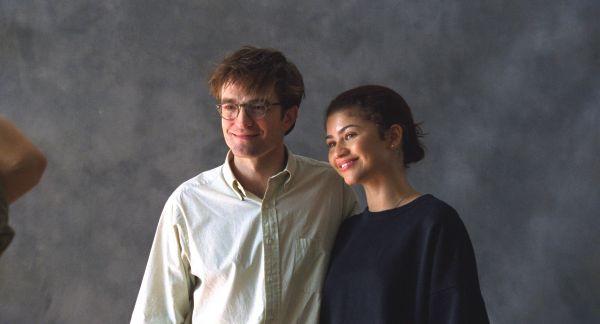
Norwegian filmmaker Kristoffer Borgli’s previous film was the surreal comedy Dream Scenario, starring Nicolas Cage. For his new film, he brings together two of Hollywood’s most sought-after young stars, Zendaya and Robert Pattinson, in a modestly scaled, sophisticated dramedy, which is no small feat. Taking a break from the major blockbusters ahead (both actors are set to appear in The Odyssey and the third “Dune” installment), they get the chance to exercise dramatic and comedic chops in a more intimate setting. They portray Emma Harwood (Zendaya) and Charlie Thompson (Pattinson), a couple about to get married, preparing their respective wedding reception speeches separately with close friends—another married couple, Rachel (Alana Haim) and Mike (Mamoudou Athie), who will serve as maid of honor and best man.
Through the drafts of the unfinished speeches, we see vignettes illustrating the “greatest hits” of the relationship. Among them is their first interaction: Charlie awkwardly approaches Emma in a café to praise the book she’s reading as one of his favorites, having Googled the title beforehand since he’s never actually read it. She doesn’t respond at all, as if he doesn’t exist, fully absorbed in her reading. Charlie retreats to his seat but gathers the courage to apologize, and only then does Emma pay attention, revealing that she hadn’t noticed him because she is deaf in one ear and had headphones in the other. (Someone reading while blasting music? Let’s assume it’s either a generational quirk or a too-convenient screenwriting device.) Other brief vignettes depict their active sex life, though they are so fleeting and insubstantial that they seem to exist solely so someone can tweet that Pattinson and Zendaya have sex scenes in the movie.
After this introduction—which almost feels like a naive imitation of the opening structure of Noah Baumbach’s Marriage Story—the film’s central conflict emerges during a dinner between the two couples. With a few too many drinks, a confession game is proposed: Each participant must reveal the worst thing they’ve ever done. When it’s Emma’s turn, her confession not only ends the game but shocks everyone present and permanently alters how they perceive her.
Of course, revealing Emma’s confession would be a major spoiler—and you can already sense how the film has been designed around that, drawing attention to something the audience must discover for themselves. Within that design lies an effective way of tying the hands of most critics, preventing them from exposing too early the shortcomings of a film that seems more satisfied with having a scandalous premise than with fully exploring it or pushing it to truly compelling extremes. What can be said is this: The relationship between Charlie and Emma is radically affected by the revelation, yet they keep their engagement intact and initially move forward with the wedding. This naturally leads to the anticipated wedding reception, where anything could happen. But if you’re expecting something on the level of Melancholia by Lars von Trier, you’ll likely come away underwhelmed.
Both Zendaya and Pattinson carry the exhausting burden of inflating what ultimately feels like a soon-to-be-deflated balloon of a movie. There is so much potential in a relationship in crisis that can be as absurd as it is terrifying, but there is no maturity in how the script handles it. It’s more concerned with how the next try-hard joke lands than with the emotional richness both lead actors could bring, laughs and all. They are at the mercy of a film that contains romance, drama, and comedy but allows none of them to fully bloom. Only Haim seems to genuinely relish her role as a relentlessly judgmental, self-unaware absolute terror (that’s a compliment).
The Drama is ultimately a shell of a film. You get a few chuckles and some difficult material designed to spark hot takes that will inevitably become part of its own marketing, whether intended or not. Some shallow commentators will label it as funny and provocative, and the marketing team will gladly use those descriptors to sell it as such. In reality, this is a film conceived to treat movie stars as products, a filmmaker’s vision as a tamed commodity, complex discussions as button-pushing exercises, and cinema as a soulless content machine.


Leave A Comment