
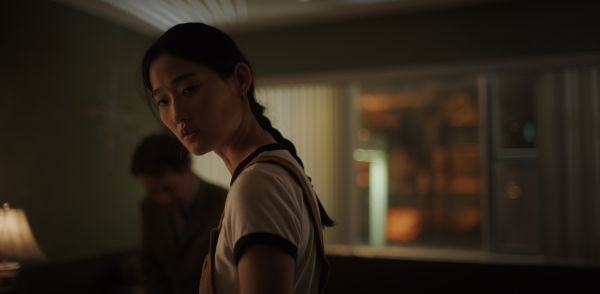
In the opening sequence of Jing Ai Ng’s Miami-set feature directorial debut, the theme of appearances versus reality immediately emerges. In a motel room, Coco (Andie Ju) is selling a piece of art to dealer Sandy Baker (a schlubby-appearing T.R. Knight in a wrinkled suit and speaking with a Southern drawl). Coco pretends that her aunt died and left her a valuable original painting, feigning knowledge about art, the artist, and its value. Demure and slight in stature, Coco seems shy and hesitant, with halting speech, but the audience soon learns of her savviness: She has forged the work herself, using a special kind of varnish to make the painting appear old, in cahoots with her brother, Raymond (Brandon Soo Hoo), who runs an underground art forgery business.
Raymond, handsome and charismatic with a spiky flat-top hairstyle, works as a server for the privileged clientele of a beach club (where a woman casually uses the term “Orientals,” one of many instances of microaggressions against the Asian siblings). They are tapped by a wealthy heir, Holden Beaumont (Edmund Donovan)—a smooth-talking but overgrown frat boy—to forge and sell replacement paintings of his inherited art collection, which was ruined in a basement flood. (By happenstance, this plot point is somewhat reminiscent of Steven Soderbergh’s recent The Christophers.)
Meanwhile, Emily (Kelly Marie Tran), a New York FBI agent in the Art Crimes Department, is investigating the source of the forgeries in Miami. Deeply knowledgeable about her field, she is met with apathy and disdain from the mostly male police force. Unknowingly, she has previously run into both Raymond and Coco at their family’s Chinese restaurant—a favorite spot of hers. As a narrative device, this feels somewhat forced and too coincidental, though it creates an interesting dynamic of trust and distrust as Emily begins suspecting members of her own ethnic community.
Ng’s film contains elements of some of Soderbergh’s work, an auteur of character-driven crime films. Leo Purman’s photography is both slick and shadowy—a contemporary Florida noir. Ian Chang and Marco Carrión’s thrumming, ambient score is reminiscent of some of composer Cliff Martinez’s moody work for Soderbergh. Despite the buildup, there’s ultimately an anticlimactic element to Emily’s role in the story. (Think Hilary Swank’s special agent character in Logan Lucky.)
Its vivid sense of place is one of the film’s strengths. Ng, who was raised in Miami, seems to know this area well: the beaches, the sunlit rooms of rambling villas, seedy motels, and karaoke bars (where Raymond performs a pitiful rendition of “American Pie,” a fitting song for characters trying to out-hustle the capitalist system). A consistent threat of hurricanes subtly looms throughout as well, adding a layer of powerlessness and anxiety.
Still, there are some drawbacks—the acting isn’t uniformly strong. Outside of the consistently believable Tran and, in a small role, Sonya Walger as a ritzy, somewhat gullible art dealer, cracks appear in nearly all of the performances at times. Ju’s deception works well in the beginning, but her presence sort of fades as the storyline progresses. The line readings occasionally feel off and unconvincing, perhaps due in part to Ng’s script, which often lays out its plot points too obviously. Despite the strong opening, I often felt a step ahead of the story, which is deadly for a picture about thieves. (Usually in these types of movies, one subversively roots for the criminals, but with the unsympathetic Holden at the helm, it was less involving.) As a result of an overall lack of tension, the film kind of hums along pleasingly enough, but toward a predictable conclusion.
However, both the specificity of setting and the Asian American-driven storylines are what make Forge memorable and help it stand apart from the typical low-stakes crime drama.







Leave A Comment