
While introducing her new film at the Toronto International Film Festival, director Mona Fastvold (The World to Come) labeled The Testament of Ann Lee as “weird.” It certainly is different. Fastvold combines two “unforgiving” genres—the biopic and the musical—and centers the story on a relatively unknown historical figure: Ann Lee (Amanda Seyfried), the founder of the Shaker movement. (I would add somber art-house fare to the genre mix.)
At the movement’s height in the early 19th century, Lee and her followers established 19 official utopian communities in the United States, mainly in New England. Their worship consisted largely of music and dancing as a way of purging sin. The name was an abbreviated version of the term Shaking Quakers, given because of their jubilant, euphoric movements. According to Fastvold, the Shakers collected more than 1,000 songs. Lee reportedly sang for hours and had a lovely voice.
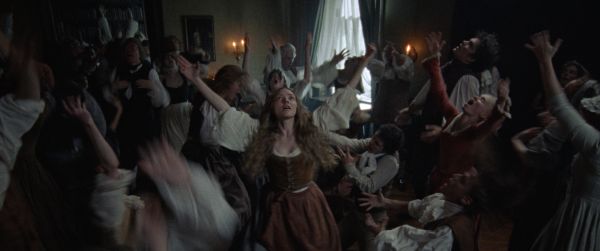
Fastvold immediately puts the viewer on notice that this is an atypical musical with a rhythmic song-and-dance opening number. Choreographed by Celia Rowlson-Hall, men and women dressed uniformly in black and white sing a rousing Shaker spiritual a cappella, moving stridently through dark woods with rigid, almost militaristic movements. The musical score is a deep cut of Americana with spirituals arranged and adapted by Daniel Blumberg. Performed acoustically and accompanied by stomping, wailing, and other vocal outbursts, the hymns turn into anthems that reveal religious conviction. The score resonates on a more sophisticated level than other recent musicals, like Joshua Oppenheimer’s The End or the blockbuster Wicked.
The filmmakers viscerally and sometimes quite graphically depict the arc of Lee’s life. Born in Manchester, England, in 1736, she was one of eight children of a blacksmith who could not afford to send her to school—the film portrays her illiteracy as a shaming secret. As a teenager, she worked as a cook in an infirmary before marrying blacksmith Abraham Standerin (Christopher Abbott) at 24 and giving birth to four children, none of whom survived early childhood. The director and her team have vividly depicted the grim days of pre-industrial England. William Rexer’s rich chiaroscuro cinematography, with interiors lit by candlelight, recalls the early Baroque paintings of Caravaggio and the Dutch Golden Age, further immersing viewers in another century, if the music and the religious debates haven’t already.
Since childhood, Lee claims she has had “heavenly visions,” and as an adult, she gravitates toward the Wardley Society, led by preacher James Wardley (Scott Handy) and his wife, Mother Jane (Stacy Martin). Their sect believed that God is both man and woman and that the Second Coming of Christ is imminent. Lee becomes a natural leader and proselytizer, taking focus in religious services by breaking into song and leading the congregation.
This explains the casting of the charismatic and multi-hyphenate Seyfried in the title role. She gets a climactic “11 o’clock number” early on with “Hunger and Thirst” while her character is imprisoned for blasphemy. There, she has a vision of herself as Christ incarnate. Seyfried possesses a crystal-clear, unvarnished, and direct soprano, and her imitation Mancunian accent is a thing of beauty. Though Lee remains steadfast, stern, and empathetic, in Seyfried’s strong-minded performance, there are flashes of strategic thinking and momentary doubt.
Along with spare furniture design, the Shakers are best known today for their practice of celibacy, the belief that the root of sin is carnal pleasure. Through abstinence, spirituality strengthens. This becomes a challenge for many of Lee’s followers, including her husband. With the aid of a benefactor, Lee and a few others cross the ocean to practice their beliefs freely, arriving in the British colony of New York. The stormy Atlantic crossing on a rickety ship lends an epic scale to her already fascinating story. (By this point, you will wonder why no one else has made a Lee biopic, although Francis McDormand did develop the experimental theater piece, Early Shaker Spirituals in 2014.) Once the party lands in 1774 Manhattan, not all obey the tenet of sexual abstinence. (Hungary handsomely stands in for New York’s Hudson Valley.)
Fastvold is not aiming for rigid religious realism, particularly when Lee and her cohorts are shown singing and provocatively thrusting their arms in a lineup facing the camera. In moments of musical ecstasy, the camera moves all over, looking down upon worshippers dancing in multiple intertwined circles—a tip of the hat to classic Hollywood musicals. Here and there, a few of the songs slow the narrative, only nudging the story forward rather than driving it.
The verbose voice-over by follower Sister Mary (Thomasin McKenzie) ties the episodic sequences together. Without it, the seams of the script’s patchwork structure would become more exposed, helping to mitigate the stop-and-go momentum. As a result, the pace occasionally becomes clunky, alternating spiritual celebrations with pivotal stops in Lee’s timeline.
For something that begins so boldly, the movie ends modestly on a muted note, as though Fastvold lost confidence in how to portray Lee’s last days. As musical finales go, it’s somber; the last act loses steam. However, the uneven and at times plodding pace is its only cardinal sin. In the context of this unique 137-minute film, it’s forgivable.
Leave A Comment