
Houses are not merely inhabited structures, but the silent witnesses of the passing of time. Oftentimes a house holds the deepest and fondest memories of one’s childhood and the passage to adulthood. Sometimes the quietude lingering within the walls accompanies laughter and tears over the many years spent there. Or the lack thereof. In Sentimental Value, the house and the silence that remains inside it are the first characters introduced, in addition to the extended family that has lived there for decades. Before we dive into the strained relationship of an Oslo theatre actress, Nora (Renate Reinsve), with her film director father, Gustav (Stellan Skarsgård), we see the roots of their conflict from very early on and the family history before then, told in a montage taking place within the light-filled house itself.
The voice-over by an unidentified character (Bente Børsum) describes the Borg family through Nora’s childhood school essay that refers to her house as a living creature. Despite her finding the essay silly when she revisits it later in life, it says a lot about Nora’s inner world and how she lives her emotions in solitude, whether it’s through words or acting. She uses anxiety as a tool to prepare for her performance on opening night—she refuses to go onstage several times and only agrees with the condition of having sex with or being slapped by her theatre worker lover, Jakob (Anders Danielsen Lie, a longtime collaborator of director/co-writer Joachim Trier). Unlike her younger sister, Agnes (Inga Ibsdotter Lilleaas), who plays the role of a diplomat in the family, Nora is not capable of communicating her feelings in her life.
Reinsve’s well-rounded performance brings a multifaceted approach to Nora, who gives her all in art. Nora has inherited her dark humor from her father, along with a childlike vulnerability, anger, and loneliness. Although the script starts off largely from Nora’s internal perspective, it connects all of the family members through the perspective of the house.
The same residence hosts an unexpected reunion when Nora and Agnes’s estranged father, Gustav, shows up unexpectedly to the gathering after their mother’s memorial service. The house bore witness to Gustav’s outbursts amidst his struggle between his focus on his work and family, and he eventually left the house and the girls to grow up without him. This witty and charismatic man immediately steals the show, also thanks to the charisma of Skarsgård. Gustav is not forthcoming with love for his daughters, at least not directly but on his own terms. He works on his own time, is unpredictable, and does what he wishes. Behind his avoidance lies a family history that goes back to World War II and the tragedies that follow as a result of his mother’s actions in the resistance against the occupying Axis Forces.
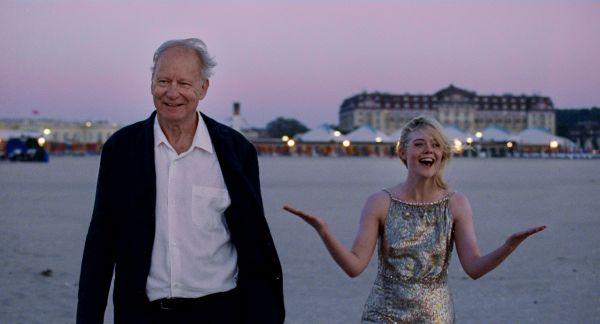
Though known as an acclaimed director, Gustav hasn’t made a film in ages and is now almost forgotten in the film industry. In an attempt to return to both his work and family, he offers Nora the starring role in a stark drama that draws influences from his life. She declines. Gustav’s invitation to the Deauville Film Festival for a retrospective of his career connects him with the famous Hollywood star Rachel Kemp (Elle Fanning). She has become enamored by him after seeing one of his previous films, a World War II drama. In this film-within-a-film, his daughter Agnes, then an adolescent, stars as the main character. Without hesitation, Rachel accepts the role that Nora has turned down.
Structured as time-lapsing vignettes, the film changes its focus occasionally as it explores different points of view. Scenes are comprised of snapshots of personal relations; therefore, the storyline is not entirely chronological but event-based. There is no confusion over time and place, and the narrative flows freely. The pace picks up when Nora tries to escape from her father and Rachel, who have made a surprise visit to the family home for research, and slows down when Agnes discovers what her grandmother endured during World War II. Unspoken family tragedies find themselves depicted here, with young Agnes appearing as a Jewish child escaping the Nazis in her father’s war film. Director Trier vividly builds a world of complicated interpersonal relationships that grow richer and reflective throughout, especially when viewed more than once.










Leave A Comment