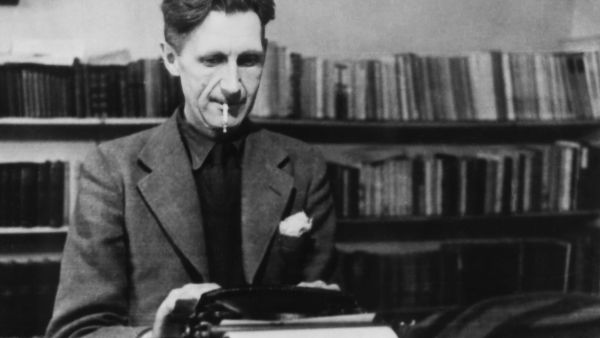
Given Raoul Peck’s background as a child refugee from Haiti’s brutal Duvalier dictatorship and his career as a socio-political filmmaker (the Oscar-nominated I Am Not Your Negro), it’s not surprising that the director chose the visionary author of 1984 and Animal Farm as the subject of his new documentary. Just over 75 years after George Orwell died in1950, his surname has become an adjective, “Orwellian,” to describe totalitarian and authoritarian social practices. With the cooperation of the Orwell Estate, Peck skillfully blends a portrait of the British writer, born Eric Arthur Blair in India in 1903, with a chilling look at the autocratic movements emerging around the world.
Opening animated shots of tuberculosis bacteria (the disease that eventually killed Orwell and an apt, if a bit heavy-handed, metaphor for the autocratic ideologies now infecting the globe) give way to images of the remote Scottish island of Jura, where the author, already ill, arrived in 1946 to write what would become his final book, 1984, initially titled The Last Man in Europe. As the camera captures the island’s stark beauty, actor Damian Lewis reads Orwell’s words in a voice-over: “When I sit down to write a book, I write it because there is some lie that I want to expose. My starting point is always a sense of injustice.”
Throughout, Peck uses excerpts from Orwell’s essays, diaries, and books to trace how Eric Blair became George Orwell. Coming from a self-described “lower upper-middle class” background, 14-year-old Blair was a “little snob.” But his transformative five years in colonial Burma, where he served as an imperial police officer, made him despise imperialism and increased his natural hatred of authority. “To be corrupted by totalitarianism,” the writer realized, “one does not have to live in a totalitarian country.” After fighting in the Spanish Civil War, Blair knew where he stood. “What I saw in Spain has given me a horror of politics.”
Structuring his documentary around the party mottos of Orwell’s Oceania (“War is peace. Freedom is slavery. Ignorance is strength.”), the director intertwines the biographical material with clips from the many film and television adaptations of 1984, as well as the 1954 animated adaptation of Animal Farm, and news footage of political situations where the fictional, nightmarish world of Orwell’s books has become reality (China, Gaza, Hungary, Myanmar, Russia, Ukraine).
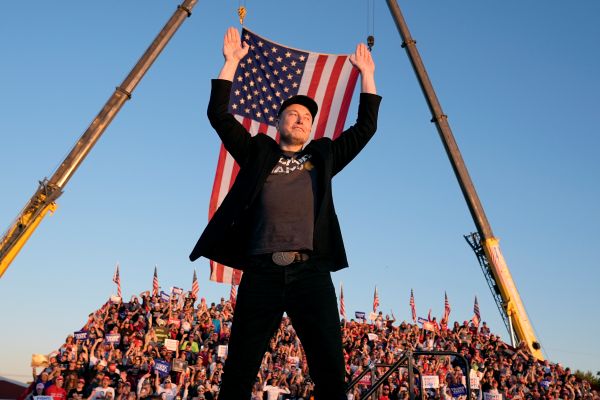
A 2003 clip of U.S. Secretary of State Colin Powell speaking at the United Nations about the “weapons of mass destruction” in Iraq is Orwell’s “War is peace” doublespeak in action. “Political language is designed to make lies sound truthful,” Lewis intones over violent images of the January 6 insurrection as Trump is heard saying, “The love in the air. I have never seen anything like it.”
Technology plays a role in this budding authoritarianism, revealed in a brief glimpse of China’s social credit system. Peck cleverly uses AI-generated art (clearly labeled as such) to connect to 1984’s themes of disinformation.
In the hands of a less skilled filmmaker, Orwell: 2 + 2 = 5 easily could have been a strident polemic, but Peck’s subtle admiration for his subject and Lewis’s rich narrative performance makes this frightening and powerful documentary a must–watch. Despite the bleak perspective, the film closes on a hopeful note, with a final shot of the infant writer and his Indian nanny and Lewis narrating, “My chief hope for the future is that the common people have never parted company with their moral code.”



Leave A Comment