
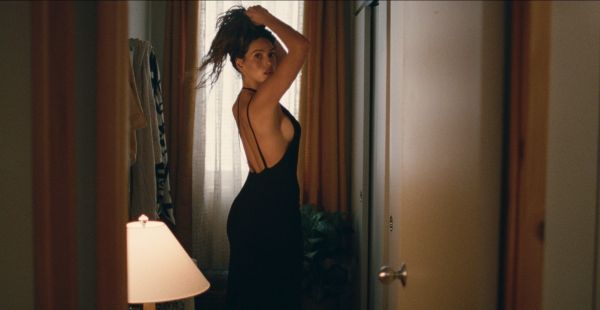
Who would have anticipated that the “remarriage comedy” would return?
Splitsville is a comedy of mismatches that seem doomed to collapse—until the next gag, twist, or confession hints at reconciliation. The suspense lies in whether two marriages will survive: Carey (Kyle Marvin) and Ashley (Adria Arjona), Paul (Michael Angelo Covino) and Julie (Dakota Johnson). Directed by Covino and co-written with Marvin, the lifelong friends and collaborators (The Climb) spin a story with enough self-deprecating humor to avoid devolving into the filmmakers’ narcissism. Yet the film remains more invested in its men than its women, despite the actresses being the bigger names.
It begins with a road trip: Carey at the wheel, singing along with Ashley, headed to the beach house of Paul, his longtime best friend. Because Ashley’s high sex drive doesn’t match her husband’s more laid-back attitude, she’s willing to try new things, like performing oral sex while he drives. Carey loses slight control of the wheel, and a car trying to overtake them flips on the highway. They stop to help, only to find the driver unconscious and the passenger dead. Since this is a comedy, the moment ends with a punchline: “Sir, why is your penis out of your pants?”
Back in the car, Ashley drops her bombshell: she has been unfaithful and wants a divorce.
Saying Carey takes it badly is an understatement. Whimpering, he bolts from the car and makes it to Paul’s house—by land and water—humiliated. Paul and Julie, seemingly the picture of a sexy, happy marriage, console him. Since Carey has questions about why his marriage failed, his friends reveal that they’ve recently opened their relationship, giving each other the freedom to be with other sexual partners. The next day, while Paul is away, Carey and Julie end up kissing, which quickly leads to more. When Paul returns, Carey casually confesses he slept with Julie, sparking one of the funniest fight scenes you’ll see all year. Brilliantly choreographed, it pauses occasionally so the men can agree not to use knives or rescue fish from the shattered aquarium.
Splitsville is essentially a portrait of male insecurity, with two men clueless about how to handle the women in their lives and terrified of losing them. Unfortunately, the film itself doesn’t know what to do with its actresses either. Arjona, so sharp in Hit Man, is sidelined, while Johnson serves mostly as a romcom archetype designed to complement her male counterparts. Here, women exist as foils to test theories or spark fantasies. The film also pokes at monogamy’s decline as a fix for relationships: Carey suggests to Ashley that instead of divorcing, they open their marriage. This proposal leads to the movie’s most delirious sequence and best joke.
Packed with sharp gags and scene-stealing side characters (Nicholas Braun, as a mentalist, wrings laughs we thought were already spent), the movie still frustrates with its conventional payoff, especially considering how relevant polyamory, open marriages, and other forms of non-monogamy arrangement are today—not least as fuel for a sexual comedy. It starts as though it might go further than Bob & Carol & Ted & Alice (1969), but ultimately it settles for The Awful Truth (1937) without the romantic spark.
The remarriage comedy once thrived because the romance felt urgent, the banter delicious, and sometimes you had Katharine Hepburn or Cary Grant—or both. Can it work today? Perhaps not, especially after Celine Song’s Materialists raised the bar just months earlier by using the romcom to make profound observations about romance, the dating world, and the forces that inevitably shape it. While Splitsville is fun to watch with all its entanglements and disentanglements, it loses steam by failing to follow through on its irreverence or offer fresh insights into modern relationships—suggesting only that when the experiments end, all that’s left is a return to business as usual. Only this time, there are no Grants or Hepburns to make it sparkle.









Leave A Comment