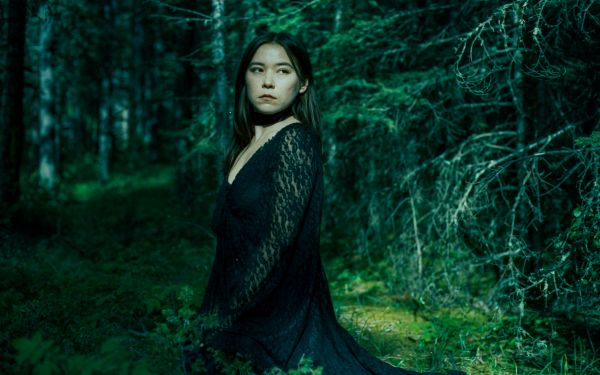
Between Amy Madigan’s Oscar-winning turn in Zac Cregger’s Weapons, the comic retail sorcery of Meredith Alloway’s Forbidden Fruits, Alice Maio Mackay’s trans-led The Serpent’s Skin, and the upcoming sequel to Practical Magic, witchcraft is in the air. In this film, shot in Alberta at the foothills of the Canadian Rocky Mountains, writer-director Avalon Fast creates a dreamy atmosphere of witchcraft afoot within a tranquil summer camp. (Fast also co-starred in The Serpent’s Skin.)
We first meet Emily (Zola Grimmer) at an awkward party where a group of early twentysomethings are seated stiffly on couches playing truth or dare. After being asked what her greatest regret is, she admits to once accidentally killing a child with her car. Everyone becomes quiet and standoffish, and Emily comes off as glum and dreary. When her more jovial, albeit wasted, friend Charlie (Giselle Morison) appears, the two decide to go to a different party. After a sudden, tragic incident on the way there, Emily feels deep shame about what happened and spirals into depression.
Her supportive father suggests she consider working as a camp counselor helping troubled young teens. Though reluctant about the camp possibly being what she calls a “God camp,” she agrees, traveling there by train. Akin to cinematic depictions of journeys to Count Dracula’s castle, the train ride to the camp is one of the eeriest scenes, with moonlit mountains glimpsed through the windows and a gothic figure, all in black, glaring at Emily as she drifts in and out of sleep.
Once at camp, Emily quickly makes friends with Rosie (Cherry Moore), one of the generally amiable and free-spirited counselors, who don bland ringer tees by day, labeled “counselor” or “leader,” and more flowy, bohemian attire by night. The clan seems to have been there year after year, probing the reticent Emily a bit and observing her closely. (These initial camp scenes are reminiscent of similar campfire-lit sequences in Joe Dante’s The Howling, in which Dee Wallace’s character settles into a remote psychiatric retreat that may be a front for something supernatural.)
Grimmer’s performance is a standout among the solid ensemble, navigating an array of emotional turmoil—when she finally expresses unbridled joy, it is almost exhilarating to watch. Backed by the electronic wash of Max Robin’s effective score, the film is slowly paced, floating in and out of dream sequences with surrealist touches. However, the premise and the trauma recovery storyline are somewhat thin for the nearly two-hour runtime. When the intentions of the counselors are ultimately explained, it makes for an exciting, devilishly fun sequence, though it could perhaps have been introduced earlier and wrapped up more quickly thereafter. The post-climactic scenes, while beautiful to look at, feel somewhat redundant.
Shot evocatively by cinematographer Eily Sprungman, the film establishes a distinct contrast between the gloomy opening scenes, where characters are bathed in shadows, and the more illustrious camp sequences, whether under bright sun, firelight, or in rooms lit by scintillating candlelight. (There’s also some sort of effect that the camera catches where the candlelight looks like luminous stars.) Despite flaws, Fast’s film still has much to offer—often proving to be a swoony, ethereal experience.
Leave A Comment